Introduction
Most enterprise teams spend roughly 40% of their time on work that shouldn't require a human at all - re-entering data between systems, chasing approvals, extracting figures from PDFs, manually validating compliance fields. It's not that organizations lack ambition; it's that basic automation only goes so far.
Traditional robotic process automation handles structured, rule-based tasks well. But what happens when the document is unstructured, the decision requires context, or the process spans multiple systems and judgment calls? That's where most automation programs stall.
Intelligent Process Automation (IPA) addresses exactly that gap. By combining AI, machine learning, RPA, and workflow orchestration, IPA can handle complex, end-to-end workflows that require pattern recognition, unstructured data interpretation, and contextual decision-making.
This guide covers what IPA is, how it differs from RPA, the core technologies behind it, real-world use cases, implementation strategy, and implementation challenges.
Key Takeaways
- IPA combines AI, ML, RPA, and BPM to automate complex workflows, including unstructured data and decision-heavy tasks
- McKinsey benchmarks: IPA can cut process cycle times by 50–60% and deliver 20–35% annual cost reductions
- Use cases cover healthcare, manufacturing, oil & gas, retail, and back-office finance
- Start with process discovery, not tool selection - pilot one use case, validate, then scale
- Governance must be embedded in architecture from day one, not added later
What Is Intelligent Process Automation - and How Is It Different from RPA?
The Core Definition
Intelligent Process Automation combines AI, machine learning, robotic process automation, and business process management to automate complex, end-to-end workflows. Unlike basic automation, IPA handles tasks that require judgment, pattern recognition, or unstructured data - things that fall outside what rule-based bots can manage alone.
McKinsey describes IPA as a suite of five integrated technologies: RPA, smart workflow, ML and advanced analytics, natural language generation, and cognitive agents. The result is a system that executes tasks, learns from outcomes, and continuously improves without requiring reprogramming.
IPA vs. RPA: Where the Line Is
RPA automates repetitive tasks by mimicking user actions through existing interfaces - clicking, copying, entering data. It works well when inputs are structured and rules are fixed. The moment a process involves variability, exceptions, or unstructured documents, RPA alone breaks down.
IPA extends RPA by adding cognitive capabilities. The result is a system that can read a contract, detect an anomaly in a financial report, or route an approval based on contextual logic - without explicit rule programming.
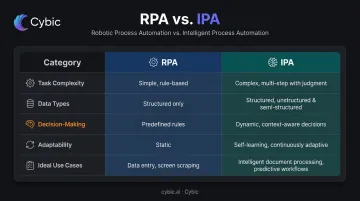
| Dimension | RPA | IPA |
|---|---|---|
| Task complexity | Simple, rule-based | Complex, judgment-dependent |
| Data types | Structured only | Structured, semi-structured, unstructured |
| Decision-making | Predefined rules | Contextual, AI-driven |
| Adaptability | Static | Learns and improves over time |
| Ideal use cases | Data entry, screen scraping | Document processing, compliance, end-to-end workflows |
How IPA Relates to Adjacent Terms
The terms intelligent automation, cognitive automation, and hyperautomation are often used interchangeably with IPA - and they largely overlap. The clearest distinction worth drawing is with hyperautomation: that term refers to the enterprise-wide strategy of applying IPA and related technologies across every automatable process simultaneously. IPA is the capability; hyperautomation is the scale at which organizations deploy it. IPA is the capability; hyperautomation is the scale at which organizations choose to deploy it. Understanding that distinction matters when scoping where automation fits into a broader transformation roadmap.
Core Technologies Powering IPA Solutions
IPA isn't a single product - it's an integrated stack. Each layer plays a distinct role.
AI and Machine Learning
AI provides the analytical foundation: processing large volumes of data, recognizing patterns, generating predictions, and improving decision quality over time. Machine learning lets IPA systems adapt without being explicitly reprogrammed - which matters when processes evolve or edge cases emerge.
RPA as the Execution Layer
Software robots handle actual task execution: navigating interfaces, entering data, triggering downstream workflows. AI tells the system what to do and when; RPA carries out the action. The two layers are complementary, not interchangeable.
NLP and Intelligent Document Processing
Natural Language Processing interprets human language in emails, contracts, chat logs, and voice interactions. Intelligent Document Processing - often paired with OCR - extracts and classifies data from unstructured sources like invoices, medical records, and regulatory filings. According to Deloitte's 2022 intelligent automation survey, 50% of organizations were already implementing OCR as part of their automation programs.
Business Process Management and Workflow Orchestration
BPM structures how automated tasks flow across systems, departments, and human handoffs. Without this layer, individual automations stay siloed. Orchestration connects them into auditable, optimizable end-to-end processes.
Process Mining and Analytics
Process mining analyzes system event logs to map how workflows actually run - not how documentation says they should. It surfaces bottlenecks and flags where automation would deliver the most value. Advanced analytics then creates feedback loops for continuous improvement.
A Unified Platform Approach
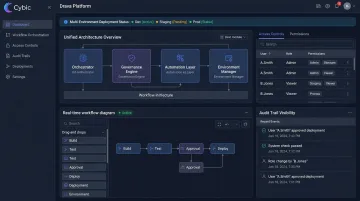
The harder challenge is making these components work as a coherent system - not assembling them individually, but governing them together. Cybic's Drava platform is built around this requirement, connecting enterprise data, ML and data science, AI reasoning, and intelligent agents into a single governed architecture.
Rather than patching together point tools, Drava provides:
- Workflow orchestration across automated and human-in-the-loop processes
- Role-based access management and security controls
- Full auditability and traceability of AI-driven actions
- Deployment across cloud, hybrid, or on-premises environments without new infrastructure silos
Key Benefits of Intelligent Process Automation
Cost Reduction and Workforce Augmentation
McKinsey's foundational IPA research estimates full IPA can automate 50–70% of tasks and deliver 20–35% annual run-rate cost efficiencies. Deloitte's 2022 survey found organizations projected an average 31% cost reduction over three years from intelligent automation programs.
The operational model shifts: high-volume, manual processes scale without proportional headcount growth, and existing teams redirect toward higher-judgment work.
Improved Accuracy and Fewer Downstream Errors
Automated systems don't experience fatigue, distraction, or inconsistency. IPA enforces the same logic across every execution, which reduces rework, cleans up downstream data, and eliminates the compounding effect of small manual errors on complex processes.
Faster Process Cycle Times
IPA removes the wait times that accumulate between manual steps. Documents get processed, data gets validated, and approvals get routed in minutes rather than over hours or days.
Two benchmarks illustrate the scale of that lag:
- APQC data puts the median invoice receipt-to-payment cycle at 15 days, with data entry alone consuming a median of 12 hours
- McKinsey estimates IPA cuts straight-through process time by 50–60% across finance, healthcare, and operations
Automated workflows eliminate most of that lag.
Enhanced Compliance and Governance
IPA enforces compliance rules consistently across every transaction. It also generates a full audit trail of every automated action - critical for healthcare, financial services, energy, and other regulated industries.
The architectural decision matters: governance embedded at design time is easier to maintain, easier to audit, and less likely to create gaps than controls added after deployment. Cybic embeds RBAC, encrypted data protection, and full auditability at the architecture level - before any code is written.
Better Experience on Both Sides
Customers receive faster, more accurate responses. Employees spend less time on data entry and more time on work that actually requires them. Both sides of that equation affect adoption - and both tend to be underweighted in initial ROI models.
IPA Use Cases by Industry
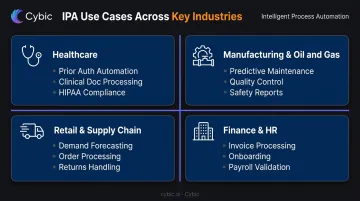
Healthcare
The administrative burden in healthcare is measurable and significant. According to the AMA, physicians complete roughly 39 prior authorization requests per week, consuming 13 staff hours per physician weekly - with 40% of practices employing staff dedicated exclusively to prior authorizations.
IPA addresses this directly:
- Automates prior authorization submission, status tracking, and exception routing
- Captures and classifies clinical documentation using AI-assisted extraction
- Extracts and validates data from unstructured billing and claims documents before submission
- Flags data access patterns and policy violations to enforce HIPAA compliance
CAQH estimates that fully electronic healthcare administrative workflows could unlock $20 billion in annual savings industry-wide.
Manufacturing and Oil & Gas
These industries generate continuous operational data - from production systems, IoT sensors, and equipment logs - and carry serious consequences for errors or delays.
IPA use cases include:
- Analyzes equipment sensor data with ML models to trigger maintenance work orders before failures occur
- Detects production exceptions automatically and generates quality control documentation
- Compiles structured regulatory safety reports directly from sensor and incident data
- Routes and tracks work orders across field operations without manual intervention
Cybic's work in these verticals connects asset monitoring, predictive analytics, and intelligent automation into unified operational workflows - providing real-time visibility across energy infrastructure and manufacturing environments.
Retail and Supply Chain
McKinsey research found that 73% of supply-chain functions still rely on spreadsheets for planning - a significant operational liability. IPA reduces that dependency through:
- Automated demand forecasting informed by real-time sales and inventory data
- Order processing and fulfillment tracking across multi-vendor supply chains
- Returns handling with automated classification and routing
- Supplier coordination workflows that reduce manual email and reconciliation
Finance, HR, and Back-Office Operations
These horizontal use cases apply across every industry and typically represent the fastest path to demonstrable ROI:
- Automates invoice processing and accounts payable workflows end-to-end
- Handles employee onboarding documentation, provisioning, and system access
- Validates payroll data and routes exceptions for review
- Classifies and routes IT helpdesk tickets to reduce resolution time
Cybic implements these workflows by combining RPA, intelligent document processing, and NLP into orchestrated systems - built to integrate with existing infrastructure rather than replace it.
How to Implement Intelligent Process Automation
Start With Process Discovery
Before selecting tools, map what you're actually automating. Use process mining, stakeholder interviews, or workflow documentation reviews to identify candidates based on four criteria:
- High volume - the process runs frequently enough that time savings compound
- Rule-heavy - clear logic can be encoded without extensive judgment
- Error-prone - manual execution produces inconsistent results
- Time-sensitive - delays in this process affect downstream outcomes
Organizations without a clear picture of their process landscape waste time and budget automating the wrong things first.
Pilot First, Then Scale Systematically
Start with one or two well-scoped use cases. The goal of a pilot isn't just to demonstrate savings - it's to validate integration assumptions, identify data quality issues, and build internal confidence before committing to broader rollout.
Once the pilot delivers, scale one department at a time - with governance and change management built into each expansion. Deloitte found that 92% of mature automation scalers were implementing or planning end-to-end automation. What separated them from stalled programs was a structured scaling approach, not technical capability.
Embed Governance From Day One
IPA implementations that treat security, access controls, and auditability as afterthoughts create problems that are expensive to fix later. The architecture needs to accommodate compliance requirements from the first design decision - particularly in regulated industries.
Cybic builds around this principle. Solutions are architected to integrate into existing infrastructure (cloud, hybrid, or on-premises) without creating new silos. Governance controls - RBAC, audit trails, encrypted data handling - are embedded before a single workflow goes live. Compliance with SOC 2, HIPAA, ISO, and GDPR is part of the system design, not a post-deployment checkbox.
Challenges and How to Overcome Them
Legacy System Integration
Most enterprises don't run on clean, modern stacks. Fragmented, aging infrastructure requires API connectivity or middleware to bridge AI tools with existing databases and applications. Prioritize integration-ready platforms that can connect to legacy systems incrementally - no full infrastructure overhaul required upfront.
Data Quality and Governance
IPA produces reliable outputs only when the inputs are reliable. Poor data quality is a leading reason pilots fail to scale. Common culprits include:
- Incomplete or missing records across source systems
- Siloed data with no common schema or ownership
- Inconsistent formats that break downstream processing
Organizations need to invest in data standardization and governance before expecting automated processes to deliver consistent results.
Change Management and Workforce Adoption
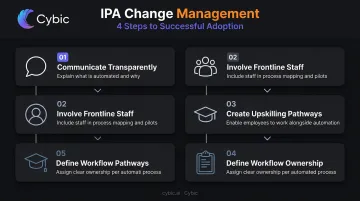
Technical implementation is often the easier half of IPA deployment. Employee resistance, unclear process ownership, and fear of displacement are consistent barriers. Successful programs address this early:
- Communicate transparently about what's being automated and why
- Involve frontline staff in process mapping and pilot validation
- Create upskilling pathways so employees can work alongside automated systems
- Define clear ownership for each automated workflow
Deloitte's research found 41% of organizations lack an enterprise-wide automation strategy - meaning most IPA programs operate without the organizational alignment needed to scale. Without that alignment, even well-configured IPA deployments stall at the pilot stage.
Frequently Asked Questions
What is the difference between intelligent process automation and RPA?
RPA automates structured, rule-based tasks using software bots that follow fixed instructions. IPA adds AI, ML, and NLP on top of RPA to handle unstructured data, make contextual decisions, and improve over time. IPA adds AI, ML, and NLP on top of RPA to handle unstructured data, make contextual decisions, and improve over time. That makes it capable of managing complex, end-to-end processes that RPA alone cannot.
What industries benefit most from intelligent process automation?
Healthcare, manufacturing, financial services, retail, and energy/oil & gas see the greatest impact. These industries share high volumes of data-intensive, compliance-driven, or repetitive operational workflows that are well-suited to AI-augmented automation.
How long does it take to implement intelligent process automation?
A focused pilot on a single well-scoped process can show results within weeks. Enterprise-wide rollouts typically take several months to over a year, depending on integration complexity, data readiness, and the number of processes in scope.
What are the biggest challenges in deploying IPA solutions?
The three most consistent barriers are legacy system integration, poor data quality, and organizational change management. Addressing data governance upfront and choosing infrastructure-agnostic platforms reduces deployment friction.
How do you measure the ROI of intelligent process automation?
ROI is typically tracked through reductions in processing time, labor cost savings, error rate decreases, and throughput increases. Establishing baseline metrics before implementation is essential. Without them, quantifying impact accurately is difficult.
Is intelligent process automation the same as hyperautomation?
No. IPA is the foundational capability - combining AI, ML, and automation to handle complex processes. Hyperautomation is the enterprise-wide strategy of applying multiple automation technologies, including IPA, to automate every possible business process at scale.