Introduction
Power plant operators face a compounding set of pressures that rule-based automation was never designed to handle. Aging workforces are retiring, taking decades of intuitive plant knowledge with them. Grid conditions are growing more complex as renewable sources introduce variability that didn't exist when most control systems were installed.
Energy demand is volatile. Decarbonization targets are tightening. And the tolerance for operational failure remains exactly zero.
Traditional automation executes predefined sequences reliably. What it cannot do is adapt, reason, or decide when conditions fall outside the script. That gap is where AI agents are being deployed.
The broader AI-in-energy market reflects how quickly this is moving. According to MarketsandMarkets, the market was valued at USD 8.91 billion in 2024 and is projected to reach USD 58.66 billion by 2030 - a 36.9% CAGR. Those numbers reflect infrastructure investment, not pilot projects.
This article covers: what AI agents are and why conventional automation falls short; where they're being deployed in power plants today; how they enable increasingly autonomous operations; and what governance requirements determine whether a deployment succeeds or stalls.
TLDR
- AI agents don't just flag problems - they act: scheduling maintenance, adjusting parameters, coordinating workflows autonomously
- Key applications include predictive maintenance, load optimization, safety monitoring, and start-up/shutdown sequencing
- Most industrial deployments sit between AI-assisted and AI-augmented - not fully autonomous, by design
- Governance, auditability, and OT/IT security must be embedded at the architectural level - not bolted on
- Legacy system integration and data quality are the most common deployment blockers
What AI Agents Are (and Why Traditional Automation Falls Short)
Rule-Based Systems Hit a Hard Ceiling
Conventional plant automation - PLCs, DCS, SCADA - is deterministic by design. It executes predefined logic against expected inputs. When those inputs deviate, the system either faults, alarms, or does nothing useful. That's not a flaw; it's the point. Reliability and repeatability are what process control demands.
The problem is that modern power plant environments generate conditions that weren't in the script: unexpected load swings, equipment degradation outside normal failure patterns, renewable integration creating real-time variability across the grid. A rule-based system cannot respond to what it wasn't programmed to anticipate.
AI agents operate differently. They continuously ingest sensor and operational data, assess conditions in real time, and act without waiting for a human to initiate each step. The behavior is closer to a skilled operator than to relay logic.
The Critical Distinction: Models vs. Agents
Standard AI and ML models generate predictions or recommendations. They tell you something is likely to happen. Acting on that information still requires a human decision.
An AI agent closes that loop. Consider predictive maintenance as an example:
- ML model approach: Sensor data analysis detects bearing wear → alert sent to maintenance team → team reviews, schedules work order, notifies operations
- AI agent approach: Same detection → agent creates work order, adjusts turbine operating parameters to reduce load on the at-risk bearing, updates shift log, flags the scheduling system - all before a human is even notified
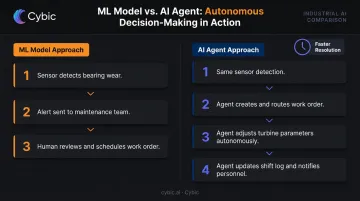
That difference matters in an environment where every hour of unplanned downtime carries significant cost and safety implications.
What Energy Environments Demand from AI Agents
Power plants cannot tolerate the probabilistic variability that makes generative AI useful in creative or analytical contexts. An agent that occasionally produces a suboptimal output in a marketing workflow is a nuisance. The same behavior in a compressor control loop is a safety event.
AI agents built for energy operations must meet a harder standard than enterprise productivity tools:
- Behave consistently within defined operating bounds - no probabilistic drift under load
- Enforce hard safety limits that optimization logic cannot override
- Log every action with enough traceability to satisfy operators, regulators, and safety inspectors
These aren't feature additions bolted onto a general-purpose AI framework. They have to be designed in from the start - at the architecture level, not the configuration layer.
Key Applications of AI Agents in Power Plant Operations
Predictive Maintenance and Equipment Monitoring
AI agents continuously ingest sensor streams from turbines, compressors, transformers, heat exchangers, and auxiliary systems. Rather than waiting for a scheduled inspection interval, they detect anomaly signatures - subtle shifts in vibration frequency, temperature gradients, flow characteristics - that indicate developing failures weeks before they become critical.
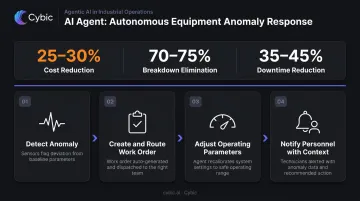
The operational value is substantial. According to the DOE FEMP Operations and Maintenance Best Practices Guide, well-executed predictive maintenance programs can:
- Reduce maintenance costs by 25–30%
- Eliminate breakdowns by 70–75%
- Reduce downtime by 35–45%
- Increase production capacity by 20–25%
What distinguishes an AI agent from a basic monitoring system is what happens after detection. The agent doesn't wait for a work order request. It can:
- Autonomously create and route the maintenance work order
- Adjust operational parameters to reduce stress on the affected equipment
- Cross-reference the maintenance schedule against production requirements
- Notify relevant personnel with context, not just an alarm code
Aker BP's Yggdrasil development puts this into practice at scale. The company has stated that AI agents will be used from day one for condition-based maintenance and planning. Thousands of sensors continuously monitor facility condition, with data structured through Cognite Data Fusion to feed predictive models.
Load Optimization and Dispatch Coordination
Matching generation output to real-time demand is a continuous balancing act that happens faster than any human team can execute at scale. AI agents make micro-adjustments across generation units in response to grid frequency signals, spot market prices, fuel costs, and contractual output obligations.
Where this gets particularly complex is multi-variable optimization across a fleet or plant with mixed generation assets. An agent can simultaneously factor in:
- Real-time fuel costs and availability
- Emissions targets and carbon accounting requirements
- Contractual delivery obligations
- Renewable input variability from co-located solar or wind assets
Siemens Energy's Omnivise Energy Management software, deployed across several power plants, uses AI to optimize dispatch for profitability and output - with reported single-digit percentage efficiency and generation output improvements. Those numbers sound modest until you apply them to a plant operating at hundreds of megawatts.
Safety Monitoring and Incident Prevention
Safety-critical monitoring is one of the strongest cases for AI agents in power plants - not because humans are unreliable, but because the speed and consistency of automated responses reduces risk exposure in ways human monitoring physically cannot match.
AI agents provide continuous surveillance across pressure, temperature, flow rates, valve states, and interlocks. When conditions approach unsafe thresholds, agents can:
- Trigger protective actions faster than manual response
- Execute isolation sequences or controlled shutdowns
- Escalate alarms with full context to the right personnel
- Maintain a continuous log of all pre-incident conditions
On offshore platforms - where the consequences of slow response are severe and the workforce is limited - this capability is central to the operating model. Yggdrasil includes unmanned and low-manned platforms (Munin is a fully unmanned production platform; Hugin A is designed to become periodically unmanned) that depend on AI-enabled anomaly detection and remote operational capability from an onshore control center in Stavanger. These deployments illustrate where AI agent applications in power and energy operations are heading: autonomous monitoring that doesn't require a human on-site to act.
How AI Agents Enable Autonomous Operations: From Assisted to Autonomous
The Operational Spectrum
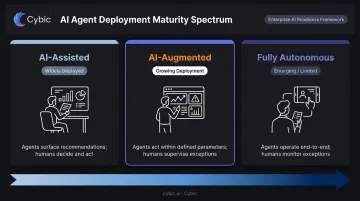
Most industrial AI deployments don't jump straight to full autonomy. They progress through recognizable stages:
| Stage | Description | Current Status |
|---|---|---|
| AI-Assisted | Agents surface recommendations; humans decide and act | Widely deployed |
| AI-Augmented | Agents act within defined parameters; humans supervise exceptions | Growing deployment |
| Fully Autonomous | Agents operate end-to-end; humans monitor for exceptions | Emerging / limited |
The middle position - AI-augmented - is where most serious industrial deployments sit today. This isn't a failure of ambition; it's the pragmatic and responsible design choice for environments with real safety consequences.
Digital Twins as the Foundation for Autonomous Action
Before an AI agent acts on a real plant system, it needs a way to evaluate consequences. Digital twins provide that capability.
A thermodynamic or physics-based digital twin mirrors actual plant equipment in a real-time simulation environment. Agents use it to:
- Simulate proposed actions before executing them
- Test responses to abnormal conditions without plant risk
- Calibrate their models against actual measured behavior
Siemens Energy's Omnivise Performance Monitoring, deployed across more than 260 power plants, uses a thermodynamic digital twin to compare actual plant-asset performance against expected optimal output and monitor degradation in real time.
Start-Up, Shutdown, and Renewable Integration
Plant start-up and shutdown sequences are among the most complex operational workflows: dozens of interdependent steps executed across precise timing windows, accounting for pressure differentials, thermal states, and subsystem readiness. An agent coordinating these sequences removes the risk of sequence errors and reduces the time operators spend on checklist execution.
Yggdrasil's target of periodic unmanned operation with remote start-up capability represents where this is heading. Full "one-button start-up" as a verified production standard remains in development, not yet operational at scale.
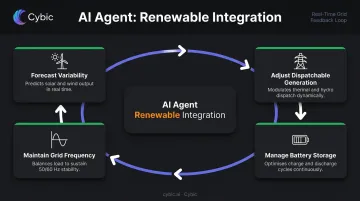
For renewable integration, agents handle the real-time mismatch problem directly. Rather than relying on manual handoffs between data sources and decisions, they operate continuously across the full stack:
- Forecast solar and wind output variability in real time
- Adjust dispatchable generation to compensate for intermittency
- Manage battery storage charge/discharge cycles
- Maintain grid frequency without operator intervention
Governance, Security, and the Human-AI Balance in Power Plants
Why Auditability Is Non-Negotiable
Regulatory bodies, safety inspectors, and insurance frameworks don't just want to know what an AI agent decided. They want to know why, with what data, under what conditions, and whether any constraints were approached or breached. Black-box models have no place in this environment.
Every AI-driven action in a power plant context must be:
- Logged with a complete data and decision trail
- Traceable back to the inputs that triggered it
- Reviewable by operators, auditors, and safety engineers
- Explainable in terms the regulatory framework recognizes
OT/IT Security as an Architectural Requirement
AI agents that operate across SCADA systems, historians, and cloud analytics pipelines improve operations, but they also create attack surfaces that didn't exist before the integration. An AI agent with write access to a DCS is a target that didn't exist before the integration.
NERC CIP standards classify BES Cyber Assets as those whose unavailability, degradation, or misuse would adversely affect reliable grid operation within 15 minutes. AI agents interfacing with these systems inherit the same security classification and protection requirements.
Security controls in this environment are not optional configurations. They're architectural requirements:
- Encrypted data pipelines, both in transit and at rest
- Role-based access controls that define what agents can and cannot act on
- Separation between OT and IT network layers with controlled, monitored interfaces
- Comprehensive audit logging of all agent actions and data access
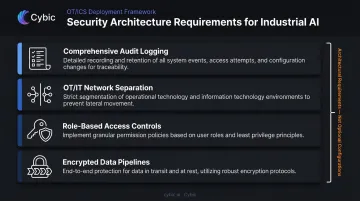
Cybic builds these controls - RBAC, encrypted data protection, auditability, and action traceability - directly into the architecture for energy and oil & gas deployments. In industrial environments, retrofitting governance after deployment is expensive and operationally risky. Embedding it from the start is the more practical approach.
Human-in-the-Loop as Responsible Design
The current operational standard is not human operators being replaced by agents - it's humans being freed from routine monitoring so they can focus on judgment, exceptions, and safety oversight.
In practice, this means:
- Agents handle data ingestion, anomaly detection, and routine parameter adjustments
- Humans retain final authority over safety-critical actions and high-stakes deviations
- Clear escalation paths define when an agent pauses and routes to a human decision
- Override mechanisms give operators the ability to intervene at any point
This isn't a limitation imposed on AI agents. It's responsible industrial design.
Challenges to Watch When Deploying AI Agents in Power Plants
Legacy System Integration
Most power plants run on SCADA, DCS, and historian systems that were engineered for reliable process control - not for real-time data exchange with AI reasoning layers. Getting an AI agent to act on reliable, current plant data requires careful OT/IT integration work before any agent logic is deployed.
That typically means:
- Mapping existing data sources and their refresh rates
- Building secure, monitored interfaces between OT and IT layers
- Validating data integrity before it enters agent decision pipelines
- Phasing deployment to avoid disrupting live operations
Skipping this groundwork produces AI agents that act on stale or incomplete data - which is worse than no agent at all.
Data Quality and Coverage Gaps
AI agents are only as effective as the data they operate on. Power plants frequently have:
- Inconsistent sensor coverage - some systems heavily instrumented, others not
- Siloed data stores - historian data separated from maintenance records, isolated from market data
- Gaps in historical records - critical for model training and anomaly baseline establishment
Addressing data quality is prerequisite work, not parallel work. An agent running on low-quality data won't just underperform - it will take confident, autonomous action on flawed inputs, compounding the original problem.
Workforce and Change Management
Operators who have managed plants through experience and intuition face a genuine trust challenge with AI agents. The solution isn't just training - it's transparency.
Operators need to understand:
- What the agent is monitoring and why
- What actions it can take autonomously vs. what requires human approval
- How to read agent outputs and assess their confidence
- When and how to escalate or override
Adoption strategy and operator training carry the same weight as the technical architecture. Even a well-engineered agent stalls in production if the people running the plant have no clear way to interpret, verify, or challenge its outputs.
Frequently Asked Questions
What are AI agents for the energy sector?
AI agents are autonomous software systems that perceive operational data, reason over it, and act on it - adjusting equipment parameters, scheduling maintenance, or rebalancing loads without waiting for human instruction. Unlike standard AI tools that surface insights for humans to act on, agents execute decisions directly.
How is AI used in power plants?
Core applications span predictive maintenance, load optimization, safety monitoring, start-up/shutdown sequencing, and renewable integration. Deployments range from decision-support tools to autonomous agents depending on a plant's operational maturity and governance readiness.
What is the difference between an AI agent and an autonomous agent?
The terms largely overlap: "AI agent" refers to the underlying technology, while "autonomous agent" describes its degree of independence. In energy contexts, the governance design matters more than the label - all production deployments involve safety constraints and defined human oversight roles.
Can AI agents operate power plants without human oversight?
Fully unattended power plant operation remains a long-term target, not today's standard. Projects like Aker BP's Yggdrasil - targeting periodic unmanned operation from an onshore control center - represent the leading edge. Current best practice keeps humans in oversight roles for safety-critical decisions.
What are the biggest challenges in deploying AI agents in power plants?
The three primary barriers are: integrating with legacy OT systems (SCADA, DCS, historians), ensuring data quality and sensor coverage across plant systems, and building operator trust through transparent, explainable AI behavior with clear human escalation paths.
How do AI agents support renewable energy integration in power grids?
Agents forecast variable renewable output in real time, adjust dispatchable generation to compensate for fluctuations, manage battery storage charge/discharge cycles, and maintain grid frequency balance - enabling higher renewable penetration without sacrificing reliability.