AI agents are different. They're designed to take on multi-step work independently - connecting to your systems, making decisions, and completing tasks without requiring human input at every stage.
This article explains what AI agents actually are, how they work mechanically, where they create measurable business value, and how to approach a deployment that holds up in a real enterprise environment.
Key Takeaways
- AI agents work toward goals autonomously, deciding what steps to take rather than following a fixed script
- Unlike chatbots or traditional automation, agents operate on objectives, not scripts or fixed rules
- High-value use cases span IT operations, customer support, finance, sales, healthcare, and manufacturing
- Deployment succeeds when clean data, embedded governance, and existing-system integration are addressed upfront
- Run a scoped pilot first, use human checkpoints to build confidence, then scale autonomy from there
What Are AI Agents for Business?
An AI agent is a software system that perceives its environment, sets or receives goals, plans a course of action, executes tasks across systems and tools, and adjusts based on feedback - with minimal ongoing human direction.
The distinction from traditional automation matters. Automation follows fixed rules and predefined triggers. If something unexpected happens, it stops or fails. AI agents operate on goals and context - when conditions change or an action fails, they adapt.
AI Agents vs. Chatbots vs. Copilots
These three categories are often conflated, but they operate very differently:
- Chatbots respond to individual inputs within scripted or semi-dynamic flows. They can't initiate actions, chain decisions, or work toward multi-step objectives on their own.
- Copilots (like most assistive AI tools) augment human workers but require human approval or direction at each step. They're useful, but the human is still doing the work of sequencing and deciding.
- AI agents are designed to complete workflows independently, with only high-level goal-setting from humans.
The progression runs from assistive tools like chatbots and copilots, through semi-autonomous agents with human checkpoints, to fully autonomous agents completing entire workflows end-to-end. Most enterprise deployments today sit in the middle of that range. That's a deliberate, sensible starting point - not a limitation.
Defining Characteristics of AI Agents
Five characteristics separate true AI agents from other automation tools:
- Autonomy: executes tasks without step-by-step direction
- Reactivity: responds to environmental changes in real time
- Proactivity: pursues goals rather than waiting for triggers
- Continuous learning: improves based on task outcomes over time
- Tool interoperability: connects to external systems, APIs, and data sources to take real-world actions
How AI Agents Actually Work
Every AI agent operates on a core loop:
- Perceive - gather context from systems, APIs, databases, or sensors
- Reason - analyze data, plan subtask sequences, select actions using LLM-based reasoning
- Act - execute tasks through tool calls, API integrations, or workflow triggers
- Evaluate - measure outcomes against the goal, update state or memory
- Loop - repeat until the objective is complete, or escalate to a human if needed
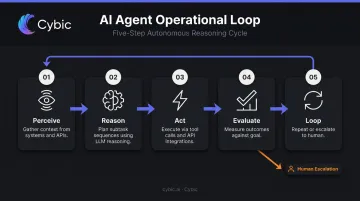
These five steps require four distinct technical components working in concert.
The Technical Components Behind an AI Agent
LLM foundation: Large language models provide the reasoning and language fluency that allow agents to interpret goals, plan steps, and generate contextually appropriate responses. The LLM drives reasoning, but without the layers below, it has no way to act on the world.
Memory layer: Agents use short-term session memory to maintain context within a task and can access long-term memory or knowledge bases across interactions. This prevents repetitive queries and enables continuous improvement across sessions.
Tool and API integration: LLMs rely on pre-trained knowledge. Agents extend this by connecting to external systems - ERPs, CRMs, databases, third-party APIs - to retrieve live data, trigger workflows, and take real-world actions.
Orchestration layer: This controls how the agent sequences actions, applies business rules or compliance constraints, coordinates with other agents, and determines when to escalate to human oversight. Governance-embedded orchestration - like Cybic's Drava platform, which provides built-in AI workflow orchestration, security controls, and governance frameworks - ensures agents operate within defined boundaries rather than operating without audit trails or access controls.
Multi-Agent Systems
Many enterprise deployments use multiple specialized agents working in coordination. One agent handles data retrieval, another handles decision-making, and a third handles execution - a division of labor that scales well beyond what any single agent can manage. Cybic architects these systems for use cases like automated supply chain management, multi-location logistics optimization, and cross-team project coordination.
High-Value Business Use Cases for AI Agents
The right starting point for any deployment: find tasks that are high-volume, rule-repetitive, data-rich, and currently creating bottlenecks. Those conditions are where agents deliver ROI fastest.
Use Cases by Business Function
Operations and IT
Agents handle the full incident lifecycle - monitoring performance, detecting anomalies, diagnosing root causes, and escalating with context summaries already written. Key capabilities include:
- Continuous system monitoring with anomaly detection
- Automated incident diagnosis and remediation attempts
- Escalation with full context summaries pre-populated for human review
AI agents can reduce mean time to resolution (MTTR) by up to 40%, cutting ticket volume and the manual triage work that consumes IT teams.
Customer support
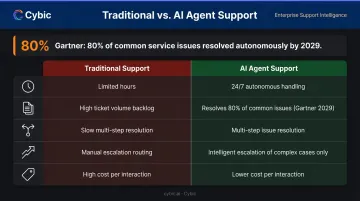
Agents handle high-volume inbound queries across channels 24/7, resolve multi-step issues like account changes or order status, and escalate only genuinely complex cases. Gartner predicts agentic AI will autonomously resolve 80% of common customer service issues without human intervention by 2029 - a number that reflects how well-suited this function is for autonomous agents.
Finance and compliance
Finance agents cover a wide range of high-volume, rules-based tasks:
- Monitor transactions for anomalous behavior and flag potential fraud
- Automate invoice processing and reconciliation checks
- Surface compliance exceptions before they become audit findings
This frees analysts from manual review cycles, shifting their time toward higher-judgment work.
Sales and marketing
Agents remove the operational overhead that slows revenue teams down:
- Qualify and enrich leads, then update CRM records automatically
- Draft personalized outreach sequences based on prospect data
- Monitor campaign performance against KPIs and flag optimization opportunities
No manual system-hopping required.
Use Cases by Industry
Healthcare
Administrative burden in healthcare is severe. American Medical Association data shows physicians complete an average of 39 prior authorization requests per week - work that rarely requires clinical judgment but consumes clinical time. AI agents can handle patient intake, appointment scheduling, prior authorization workflows, and clinical documentation summarization, improving care coordination without compromising data governance.
Oil & Gas and Manufacturing
Unplanned downtime in these sectors carries enormous costs. Agents address this by:
- Monitoring equipment in real time and triggering predictive maintenance workflows
- Running automated safety compliance checks
- Coordinating supply chain responses when anomalies appear

Catching failure signals early - before equipment goes down - is where the ROI is clearest. Cybic deploys AI agents across energy infrastructure and manufacturing environments, building directly into existing operational technology stacks and compliance requirements from the start.
What to Look for Before Deploying AI Agents
Three factors determine whether an agent deployment succeeds or stalls.
Data Readiness
Agents are only as reliable as the data they work with. Poorly organized, siloed, or inconsistent data leads directly to incorrect outputs - and once trust in an agent erodes, it's hard to recover.
Cybic's assessment work consistently surfaces the same enterprise reality: roughly 80% of enterprise data is unstructured or siloed before AI work begins. Resolving this is the actual foundation of any deployment.
Before deployment, organizations should ensure:
- Clean, structured data pipelines with consistent formatting
- Defined data ownership and governance policies
- Integration-ready access to relevant source systems
Governance, Security, and Auditability by Design
Clean data gets agents running. Governance keeps them running safely. Enterprise AI agents must operate under role-based access controls, encrypted data handling, and full auditability of agent actions - and these need to be designed in from the start, not bolted on later.
Cybic embeds governance at the architectural level across every deployment:
- RBAC controls what each agent and user can access
- Encrypted data protection in transit and at rest
- Audit trails that capture every agent decision and action
- Compliance alignment with SOC 2, HIPAA, ISO, and GDPR where applicable
- No model training on proprietary enterprise data - a hard policy
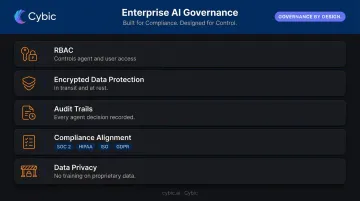
When governance is embedded at the architecture level, agents can operate with meaningful autonomy - because the guardrails are already built into how they function.
Integration with Existing Infrastructure
Well-designed AI agents connect to current systems - ERP, CRM, ITSM, data warehouses - without requiring those systems to be replaced. Prioritize deployment approaches that are infrastructure-agnostic and work across cloud, hybrid, and on-premises configurations.
Cybic's approach is built around this operational reality. Solutions integrate into existing infrastructure from day one across AWS, Azure, and Google Cloud, with custom API development to connect agents to the tools organizations already use.
How to Get Started: A Practical Approach
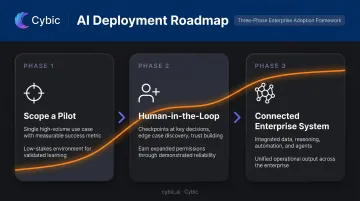
Phase 1: Scope a Pilot
Choose a single, high-volume use case with measurable outcomes and a defined success metric. Examples:
- Reduce IT ticket resolution time by X%
- Handle Y% of tier-1 customer queries autonomously
- Cut invoice processing time from days to hours
Avoid starting in high-stakes, high-ambiguity environments. The goal of a pilot is to build evidence, not to prove the technology works under the hardest possible conditions.
Phase 2: Start with Human-in-the-Loop
Deploy initial agents with human checkpoints at key decision points. This builds organizational trust, surfaces edge cases before they become incidents, and validates performance in your actual environment - not a sandbox.
Expand autonomy only after the agent has demonstrated reliable behavior at each checkpoint. Governance controls should already be embedded at the architecture level. Expanding scope means the agent has earned wider permissions - not that oversight has been reduced.
Phase 3: Build Toward a Connected System
Individual agents proving value in isolation are just the foundation. MIT CISR research finds that companies with advanced enterprise AI significantly outperform industry peers on financial metrics - and that performance gap comes from connected, integrated AI capabilities, not a collection of standalone tools.
The strategic goal is connecting data, reasoning, automation, and agents into a unified operational system. Cybic's Drava platform supports this progression directly: it moves organizations from isolated deployments toward governed, enterprise-wide AI automation where each connected workflow increases the system's overall output.
Frequently Asked Questions
What is the difference between an AI agent and a chatbot?
Chatbots respond to individual prompts within scripted or semi-dynamic flows and cannot take action across systems. AI agents independently pursue multi-step goals, connect to external tools, and adapt based on results, all without requiring human direction at each step.
What is the difference between an AI agent and an AI copilot?
Copilots augment human workers and require human approval before proceeding at each stage - the human remains in the decision loop. Agents are designed to complete entire workflows autonomously, receiving only high-level goal inputs from humans.
How long does it take to deploy AI agents for a business?
Platform-based agents with pre-built integrations can go live in weeks. Custom enterprise deployments typically take several months, with timelines driven by integration complexity, data readiness, and the governance requirements of your specific environment.
Do AI agents require replacing existing systems and technology?
No. Well-designed agents integrate into existing infrastructure (CRM, ERP, ITSM, databases) via APIs, with no legacy system replacement needed. The key is choosing an infrastructure-agnostic deployment approach from the start.
How do businesses ensure AI agents are secure and compliant?
Through role-based access controls, encrypted data handling, full audit trails of agent actions, and human oversight checkpoints at defined decision stages. Governance must be embedded at the architectural level, not added as an afterthought once deployment is underway.
What industries benefit most from AI agents?
Industries where operational volume is high and workflows are data-heavy tend to see the strongest returns. Healthcare, financial services, manufacturing, retail, energy, and the public sector all represent proven deployment environments.