Introduction
Healthcare organizations are under real operational pressure. Administrative bottlenecks, front-desk staffing gaps, and climbing patient volumes are pushing teams toward AI automation - but healthcare data operates under strict federal law, and most general-purpose AI tools were never built to handle it safely.
The stakes are concrete. According to IBM's 2025 Cost of a Data Breach Report, the average healthcare data breach costs $7.42 million - the highest of any industry. That number reflects not just regulatory penalties but breach remediation, reputational damage, and operational disruption.
AI agents offer measurable efficiency gains across patient access, revenue cycle, and clinical documentation. But deploying them incorrectly with protected health information (PHI) creates serious legal and financial exposure.
The difference between a compliant deployment and a non-compliant one often isn't visible from the outside. It lives in architecture, vendor agreements, and configuration decisions that never appear in a product demo.
Understanding that gap is what this guide is for. It covers what HIPAA compliance actually requires of AI systems, which technical safeguards must be in place, the highest-value use cases, how to evaluate vendors, and what a compliant implementation looks like in practice.
Key Takeaways
- AI tools marketed for healthcare are not automatically HIPAA-compliant - compliance depends on architecture, vendor agreements, and how the system is deployed
- Any AI vendor handling PHI must sign a Business Associate Agreement (BAA); without one, using the tool is itself a violation
- The highest-ROI use cases are patient scheduling, revenue cycle management, clinical documentation, and compliance monitoring
- Vendor evaluation should go beyond marketing claims: verify BAA availability, encryption standards, zero-retention LLM agreements, audit logging, and RBAC controls
- Governance embedded in the architecture - not bolted on after deployment - is what makes healthcare AI work in regulated environments
What Does It Mean for an AI Agent to Be HIPAA-Compliant?
A HIPAA-compliant AI agent is a software system that automates workflows involving protected health information (PHI) while satisfying the HIPAA Security Rule (45 CFR Part 164) and, where applicable, the Privacy Rule.
HIPAA compliance is a shared responsibility - between the healthcare organization and every vendor that touches patient data. No vendor ships a "certified compliant" product. Compliance depends on how the system is built, configured, and deployed.
The Business Associate Agreement Requirement
Under 45 CFR 160.103, any vendor that creates, receives, maintains, or transmits PHI on behalf of a covered entity legally qualifies as a Business Associate. That includes AI vendors handling appointment data, clinical notes, insurance information, or any other patient-identifiable information.
A signed BAA is required before that vendor can legally touch PHI. Without one, using the tool to process patient data is itself a HIPAA violation - regardless of how secure the technology appears on paper.
Compliant Vendor ≠ Compliant Deployment
A vendor can hold SOC 2 Type II certification, offer a BAA, and still be deployed in a way that violates HIPAA. This trips up healthcare teams more often than most expect. Configuration decisions, data flow architecture, logging practices, and third-party integrations all determine whether a deployed AI system actually meets the standard.
The LLM Architecture Problem
When an AI agent sends patient conversation data to an external large language model (LLM) via API, that data transfer creates additional compliance obligations - and it's one of the most common failure points in AI deployments. Organizations must confirm that:
- The LLM provider has signed a BAA
- The provider does not retain or train on the submitted data
- Ideally, a zero-retention agreement is in place
AI agents that retain full conversation logs indefinitely, or that access patient records beyond their workflow scope, create compliance exposure even when the underlying infrastructure is secure.
The Minimum Necessary Standard
HIPAA requires that systems access and process only the minimum PHI needed to accomplish a specific task. An AI agent that pulls a patient's full medical history to confirm an appointment time isn't just over-engineered - it's non-compliant.
Core HIPAA Requirements AI Agents Must Satisfy
The HIPAA Security Rule specifies three safeguard categories that apply directly to AI systems. These are the non-negotiable minimums for any healthcare AI deployment.
Administrative Safeguards
- Workforce training on PHI handling procedures
- Risk analysis and risk management programs
- Access management policies defining who can authorize system permissions
- Regular review of information system activity
BayCare Health System's 2025 OCR settlement ($800,000) was partly attributed to failures in implementing access authorization policies and reviewing information system activity - standard Administrative Safeguard requirements.
Physical Safeguards
- Secure data center hosting with physical access controls
- Hardware security for encryption key storage
- Device and workstation security policies
Technical Safeguards
Per 45 CFR 164.312, four controls are required:
| Control | Requirement |
|---|---|
| Access Controls | Allow PHI access only to authorized persons or software programs |
| Audit Controls | Record and examine activity in systems containing PHI |
| Integrity Controls | Protect PHI from improper alteration or destruction |
| Transmission Security | Guard against unauthorized access to PHI over electronic networks |
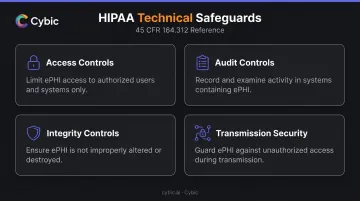
For AI agents, these requirements extend to every component in the pipeline - including LLM inference API calls, conversation transcripts, integration APIs, and cached intermediate outputs. PHI must be encrypted at rest and in transit across all of these layers.
Audit Logging as a Compliance Requirement
HIPAA §164.312(b) mandates audit logging - it's not optional. For AI agents, every PHI access, every AI-generated action, and every human override must be captured with timestamps, user identity, and action details. These logs support both compliance reporting and breach investigation.
Role-Based Access Controls in Multi-Agent Systems
Audit logs tell you what happened. RBAC determines what's allowed in the first place - and in multi-agent systems, getting this wrong creates significant exposure.
Each agent in a multi-agent architecture handles different data and should carry different permissions:
- Scheduling agents access appointment and availability data only
- Prior authorization agents interact with insurance and clinical criteria records
- Clinical documentation agents read and write to patient charts within defined scope
Over-permissioned agents can silently access data outside their workflow, which doesn't always trigger alarms but does create compliance liability. Granular RBAC closes that gap by enforcing boundaries at the agent level, not just the user level.
High-Value Use Cases for HIPAA-Compliant AI Agents in Healthcare
The highest-ROI applications fall into four operational domains: patient access, revenue cycle management, clinical documentation, and compliance monitoring. Each involves PHI and requires compliant architecture - and each delivers measurable operational impact.
Patient Access and Scheduling Automation
AI agents can handle inbound and outbound patient communication around the clock - appointment scheduling and confirmations, intake form collection, prescription refill routing, and post-visit follow-ups - without requiring front-desk staff for every interaction.
HIMSS data shows average yearly no-show rates run just under 20%, and automated reminder systems have produced 5–10% reductions in missed appointments across multiple studies. MGMA identifies no-shows as a top patient access priority for 2026, cited by 27% of practices.

Compliance architecture for scheduling agents requires:
- Caller identity authentication before accessing records
- Access scoped to scheduling and demographic data only (not full clinical records)
- All interactions logged with timestamps and action details
- EHR/practice management system integration through HIPAA-compliant APIs, not screen-scraping
Revenue Cycle Management
Prior authorization alone consumes 13 hours per week per physician and generates 40 PA requests weekly. Sixty percent of physicians employ staff who work exclusively on PA tasks. AI agents can absorb eligibility verification, PA initiation and status follow-up, and claims status checking - cutting the administrative load on clinical staff and accelerating AR cycles.
One compliance nuance specific to RCM: AI agents navigating payer IVR systems and speaking with insurance representatives are handling PHI in real-time voice interactions. Compliant architecture requires:
- Encrypted call handling for all voice-based PHI exchanges
- Structured data write-back to the EHR after each transaction
- Audit trails capturing every payer interaction, not just stored records
Clinical Documentation Assistance
Primary care physicians spend an average of 36.2 minutes on EHR documentation for a visit scheduled to last 30 minutes. AI agents can reduce that burden by capturing ambient clinical conversations, suggesting ICD-10 and CPT codes, and generating draft clinical notes.
Physician review of AI-generated content is both a compliance requirement and a liability safeguard. AI suggestions must be clearly distinguished from finalized physician documentation in the medical record, and audit trails must capture which suggestions were accepted, modified, or rejected.
Compliance Monitoring and Audit Automation
AI agents deployed as internal compliance monitors continuously scan PHI access logs, detect anomalous query patterns - bulk data exports, after-hours access to sensitive records - and alert compliance officers in real time. OCR received 30,256 new HIPAA complaints in 2024 and initiated 730 compliance reviews, a volume that makes manual monitoring impractical at scale.
One important caveat: AI agents used for compliance monitoring must themselves satisfy the same RBAC, encryption, and logging requirements as any other PHI-touching system. Read access to audit data is still PHI access.
What to Look for When Evaluating HIPAA-Compliant AI Agents
Five Criteria That Matter Beyond Marketing Claims
- BAA as a standard offering - not a premium add-on or a negotiation item
- Documented encryption for data at rest and in transit across the full AI pipeline
- Zero-retention or no-training agreements with underlying LLM providers
- Audit logging that captures AI-driven actions with enough detail for compliance review
- RBAC granularity sufficient to scope permissions per agent, per workflow, and per data type
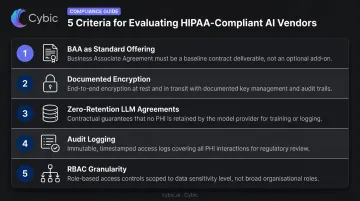
When evaluating vendors against these criteria, the key question is whether the controls exist in the architecture or in a configuration checklist that may or may not be applied consistently. Cybic, for example, embeds security controls, access management, and auditability at the architectural level rather than configuring them post-deployment - a meaningful distinction when compliance failures often trace back to setup gaps, not missing features.
EHR Integration Depth
Integration method is also an evaluation criterion, not just a technical detail. An AI agent that connects to Epic, Cerner, or athenahealth through FHIR/HL7 APIs is both more useful and more compliant than one that relies on workarounds. Structured API integrations create auditable data flows with clear provenance. Screen-scraping and unsecured data exports don't, and they introduce gaps that may not surface until an audit or breach investigation.
The Demo-Compliant Failure Mode
Many vendors appear HIPAA-compliant in controlled demonstrations but fail under production conditions - particularly around logging completeness, data residency, subprocessor transparency, and incident response timelines.
Before committing, ask vendors for:
- Security documentation and data flow diagrams
- Penetration test reports (within the last 12 months)
- Uptime and incident response SLAs
- References from regulated healthcare deployments in production
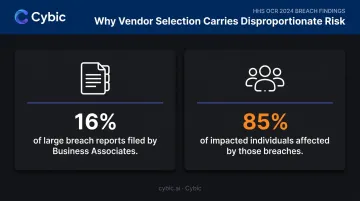
The due diligence gap carries real consequences. HHS OCR's 2024 breach report found that business associates filed only 16% of large breach reports but affected 85% of impacted individuals - which is why vendor selection carries disproportionate risk in healthcare AI deployments.
Deploying HIPAA-Compliant AI Agents: Key Implementation Considerations
Start with a Pilot Workflow
Pick one or two high-volume, high-friction administrative workflows - appointment scheduling or benefits verification are the most common starting points. Deploy there first, with defined KPIs:
- Call containment rate
- No-show or abandonment rate
- Cost per interaction
- PA cycle time (for RCM pilots)
This approach limits PHI exposure surface during the initial phase and gives teams time to validate compliance controls under real conditions before expanding scope.
Build a Governance Structure for Ongoing Compliance
Ongoing compliance requires more than a successful launch. Specifically:
- Regular review of AI agent performance logs
- Periodic audit of PHI access patterns
- A defined escalation path for compliance anomalies
- A process for updating AI workflows when regulations or clinical protocols change
Cybic's engineering-led delivery model builds auditability and traceability of AI-driven actions as a built-in feature - not something configured after the fact. That reduces the governance burden on clinical operations teams managing multiple systems without dedicated compliance staff for each.
The Infrastructure Decision
HIPAA does not mandate on-premise hosting. What it requires is that wherever PHI is processed and stored, the environment satisfies Security Rule requirements. AWS, Azure, and Google Cloud all offer HIPAA-eligible services with available BAAs - and Cybic deploys across all three.
Healthcare organizations with strict data sovereignty requirements may prefer private cloud or on-premise configurations. Others can operate compliantly in public cloud environments. Either way, the infrastructure decision should be made deliberately - with compliance requirements as a primary input, not a post-deployment checkbox.
Frequently Asked Questions
Is AI in healthcare HIPAA compliant?
AI in healthcare can be HIPAA compliant when deployed on secure infrastructure, with a signed BAA, proper encryption, access controls, and audit logging in place. It is not automatically compliant because it is marketed for healthcare use - compliance depends on both vendor capabilities and how the system is configured and operated.
Which AI agents are HIPAA compliant for hospitals?
HIPAA-compliant AI agents for hospitals meet these core criteria:
- Signed BAA agreements with documented liability terms
- Encryption standards covering data at rest and in transit
- EHR integrations via FHIR/HL7 APIs
- Zero-retention LLM agreements for PHI processing
- Audit logging across all patient data touchpoints
These platforms support use cases from patient scheduling and prior authorization to clinical documentation. Evaluate vendors against these criteria rather than relying on self-reported claims.
What is a Business Associate Agreement and why do AI vendors need to sign one?
A BAA is a legally required contract under HIPAA between a covered entity and any vendor that handles PHI on their behalf. It specifies how the vendor will protect the data, breach notification obligations, and liability allocation. Any AI agent that processes patient information - voice calls, scheduling data, clinical notes - qualifies as a Business Associate and must have a signed BAA before going into production.
What HIPAA Technical Safeguards must AI agents implement?
Under §164.312, AI agents must implement four technical safeguards:
- Access controls limiting PHI to authorized users and systems
- Audit logging recording who accessed what and when
- Data integrity controls preventing unauthorized alteration
- Transmission security (TLS encryption) protecting PHI in transit
These requirements apply to every component in the pipeline, including LLM inference calls and integration APIs.
Can an AI agent access EHR data without violating HIPAA?
Yes - when the agent connects through FHIR/HL7 APIs under a BAA, accesses only the minimum necessary data for the specific task, logs all access with sufficient detail for audit review, and operates within an RBAC framework that restricts permissions to the agent's defined workflow scope.
What are the risks of deploying non-compliant AI in healthcare?
HIPAA civil monetary penalties range from $145 per violation (Tier 1) up to $2,190,294 per violation with the same annual cap (Tier 4), per the 2026 inflation adjustment. Financial penalties are only part of the exposure - non-compliant deployments also carry reputational damage, operational disruption from breach remediation, and class-action litigation risk. In March 2026, HHS OCR settled with MMG Fusion - a healthcare software business associate - over a breach affecting approximately 15 million individuals, citing impermissible disclosure, failure to conduct a risk analysis, and failure to notify covered entities.