Key Takeaways
- HIPAA compliance requires administrative, physical, and technical safeguards - not just a vendor's self-proclaimed badge
- Any chatbot vendor handling PHI is a Business Associate and must sign a BAA covering all subprocessors
- Consumer AI tools (ChatGPT, Claude free tier) cannot be used with patient data under any circumstances
- The highest-value use cases are scheduling, intake, eligibility routing, reminders, and after-hours FAQ deflection
- Vendor evaluation requires documented proof: SOC 2 Type II audit, signed BAA, full subprocessor list, and no-training confirmation
Introduction
Patients now expect instant, 24/7 digital responsiveness from their healthcare providers. According to a 2024 AHA survey, nearly 1 in 5 consumers switched providers in the prior year - and almost 90% left because the organization was hard to do business with, with access cited as the deciding factor by 70% of them.
The pressure to deploy AI chatbots is real - and so is the legal exposure of getting it wrong.
Healthcare data is among the most regulated information in existence. In 2024, HHS OCR received 663 large breach notifications affecting over 242 million individuals.
A single misconfigured AI deployment - routing patient data through a non-compliant vendor, skipping a Business Associate Agreement, using a consumer AI tool - can trigger breach notification obligations, federal investigations, and civil penalties.
This guide gives healthcare IT leaders, compliance officers, and practice administrators a clear framework: what HIPAA compliance actually requires from an AI chatbot, which use cases justify deployment, and what to demand from vendors before signing anything.
What "HIPAA-Compliant AI Chatbot" Actually Means
HIPAA compliance is a specific legal framework governing how Protected Health Information is collected, stored, transmitted, and accessed - not a feature toggle or a marketing badge. A chatbot is only compliant when its entire stack - the application, the underlying model, the hosting infrastructure, and every third-party subprocessor - meets those requirements.
What Counts as PHI in a Chatbot Conversation
Under HIPAA, PHI is any individually identifiable health information transmitted or maintained in any form. In a chatbot context, that includes:
- Patient names paired with a health condition or appointment
- Dates of service, diagnoses, or treatment information
- Insurance IDs, member numbers, or prior authorization details
- Contact information (email, phone number) linked to a health record
Not every healthcare chatbot triggers full HIPAA obligations. A bot answering general questions about parking, office hours, or service descriptions - with no PHI in the conversation - sits in a different category than one collecting intake information or integrating with an EHR.
The distinction matters when evaluating vendors. The requirements for a general-information bot and a clinical intake assistant are not the same.
The Business Associate Designation
When a chatbot vendor processes, stores, or transmits PHI on behalf of a covered entity, they become a Business Associate under HIPAA. This is a legal designation with specific obligations - not just a vendor relationship.
HHS is explicit that this applies even to cloud providers that maintain ePHI without a decryption key. The vendor does not need to read your data to qualify. Hosting it is enough.
The Three Safeguard Categories
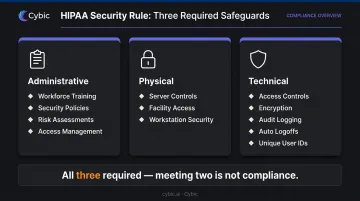
That Business Associate relationship comes with enforceable requirements. HIPAA's Security Rule requires all three of the following - meeting two out of three is not compliance:
| Category | What It Covers |
|---|---|
| Administrative | Workforce training, security policies, risk assessments, access management procedures |
| Physical | Server and device controls, facility access, workstation security |
| Technical | Access controls, encryption, audit logging, automatic logoffs, unique user IDs |
One more distinction matters here: "HIPAA eligible" is not the same as "HIPAA compliant." A platform may be architected to support compliance when properly configured - but actual compliance depends on how it is configured and operated. Healthcare organizations bear responsibility for closing that gap.
Why Standard AI Tools Cannot Be Used in Healthcare
Consumer versions of popular AI tools are unsuitable for any healthcare use involving PHI. This is not a gray area.
The Data Training Problem
OpenAI's own documentation states that consumer ChatGPT content may be used to train models unless the user opts out. ChatGPT Business does not offer a BAA at all. Anthropic distinguishes its consumer products (Claude Free, Pro, Max) from commercial offerings, and may provide a BAA only after review for eligible services. These are not policies that healthcare organizations can work around by being careful.
Without the right product tier and a signed BAA, routing PHI through these tools is a HIPAA violation.
The enforcement record makes the consequences concrete:
- Oregon Health & Science University - $2.7 million HHS OCR settlement after ePHI was stored on a cloud server without a BAA
- Raleigh Orthopaedic Clinic - $750,000 settlement specifically citing failure to execute a BAA before transferring PHI to a vendor
The Hallucination Risk in Clinical Contexts
General-purpose AI models generate plausible-sounding but potentially incorrect information. In healthcare, this is a patient safety issue, not just a quality concern.
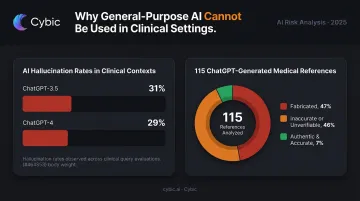
Research published in JAMA Ophthalmology found mean hallucination rates of 31% for ChatGPT-3.5 and 29% for ChatGPT-4 when generating ophthalmic scientific references. A separate medical study found that of 115 ChatGPT-generated references, only 7% were both authentic and accurate - 47% were fabricated outright.
A HIPAA-compliant chatbot designed for healthcare must confine responses to approved, verified knowledge sources. When a model can fabricate nearly half its citations, open-ended generation on clinical topics is not a risk to manage - it's a design flaw to eliminate.
Where HIPAA-Compliant AI Chatbots Deliver Real Value
The strongest case for healthcare chatbots is not clinical AI - it's administrative automation. These are the use cases with clear compliance boundaries and measurable operational ROI.
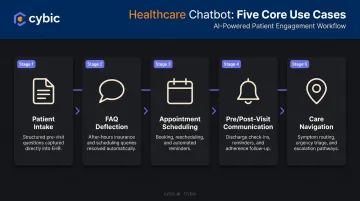
Patient Intake and Pre-Visit Automation
Conversational intake - structured questions about reason for visit, current medications, insurance - delivered through a compliant chatbot reduces paper-based friction and drops structured data directly into the EHR. It replaces one of the most universally disliked patient experiences without requiring any clinical staff involvement.
FAQ Deflection and After-Hours Support
MGMA data found that the most time-intensive phone tasks at medical practices were eligibility and prior authorization (45%) and scheduling (31%). A well-trained chatbot handles routine questions about accepted insurance, hours, parking, and pre-procedure preparation 24/7 - without adding headcount or leaving after-hours inquiries unanswered.
Appointment Scheduling and Reminders
Automated booking, rescheduling, and cancellation workflows let patients self-serve at any hour. A JAMIA systematic review cited a global average outpatient no-show rate of 23%, and found that automated reminders were associated with significantly lower no-show rates. Integration with scheduling and EHR systems is a core requirement for any deployment in this category.
Pre- and Post-Visit Communication
Automated pre-procedure reminders, post-discharge check-in surveys, and medication adherence follow-up all require consistency and timeliness more than clinical judgment. These workflows are natural fits for chatbot automation. The key design requirement: a clear escalation path to a clinician whenever a patient's response warrants one.
Care Navigation and Triage Routing
A chatbot can ask structured questions to direct patients to the right specialist, appropriate urgency level, or - when symptoms warrant - emergency services. This is administrative routing based on defined criteria, not clinical diagnosis. Specific tasks this covers:
- Directing patients to the right specialist or care level based on symptom inputs
- Flagging urgent responses for immediate staff follow-up
- Routing non-urgent questions to self-service resources
- Escalating to emergency guidance when responses meet defined thresholds
No HIPAA-compliant healthcare chatbot should attempt to perform clinical diagnosis. The boundary matters - both for patient safety and regulatory standing.
Non-Negotiable Features Every HIPAA-Compliant AI Chatbot Must Have
Business Associate Agreement
If a vendor cannot or will not sign a BAA, stop the evaluation. No further discussion is necessary.
The BAA must cover every product, feature, and subprocessor that will touch PHI - not just the core platform. If the chatbot routes conversations through a third-party LLM, that LLM provider needs to be covered. If conversation transcripts are stored in a cloud environment, that cloud provider needs to be covered.
Encryption and Data Security
Request documentation, not just claims. The technical standards to verify:
- Data in transit: TLS 1.2 or higher (NIST SP 800-52 Rev. 2 requires TLS 1.3 support as of January 2024)
- Data at rest: AES-256 encryption (NIST FIPS 197 benchmark)
- Scope: Every message, every conversation transcript, every uploaded document
HIPAA's Security Rule is risk-based and does not name specific algorithms by statute - but these NIST-aligned benchmarks are the accepted standard. Vendors should document where and how they apply.
Access Controls, Audit Logging, and Tenant Isolation
Three distinct requirements, all mandatory:
- RBAC limits PHI access to those with a legitimate, role-specific need
- Immutable audit logs capture every PHI-involving interaction with timestamps and user identity
- Tenant isolation ensures each organization's patient data is cryptographically separated from other customers on the same platform
Architectures that embed these controls at the design level - not as optional configuration - provide stronger compliance assurance. When security is foundational rather than configurable, controls cannot be inadvertently bypassed during updates or reconfiguration.
AI Governance and Model Training Safeguards
Some platforms use customer conversation data to train or improve their underlying models. In healthcare, that means patient information could become training data - a serious HIPAA risk.
Require written confirmation that:
- The vendor maintains zero-retention agreements with any third-party LLM providers
- PHI is never used to train, fine-tune, or evaluate AI models
- This commitment extends to all subprocessors in the stack
Cybic's policy of no model training on proprietary enterprise data applies to all healthcare engagements and is embedded at the architecture level - not configurable as an opt-out.
Deployment Flexibility
Healthcare organizations with strict data residency requirements, or operating in states with privacy laws that exceed federal HIPAA standards, often require on-premises or private cloud deployment instead of shared public cloud infrastructure.
Vendors that support all three deployment models - cloud, hybrid, and on-prem - without locking organizations into a single infrastructure give compliance teams more room to adapt as state-level requirements tighten.
How to Evaluate and Choose the Right Solution
Documentation to Request Before Signing
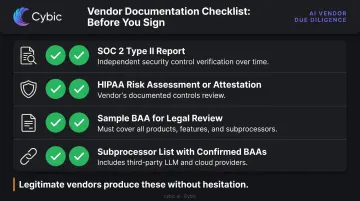
Legitimate vendors produce these without hesitation. Any vendor that can't provide the following warrants serious scrutiny:
- SOC 2 Type II report - independent verification of security controls over time, not a point-in-time self-assessment
- HIPAA risk assessment or attestation - the vendor's own documented review of their controls
- Sample BAA for legal review - confirm it covers all products, features, and subprocessors
- Subprocessor list with confirmed BAAs for any third-party LLM or cloud providers
Questions That Separate Serious Platforms from Marketing Language
The answers reveal whether compliance is architectural or cosmetic:
- Where exactly is data stored, and who can access it?
- Can data be exported and permanently deleted upon contract termination?
- What is the incident response procedure and breach notification timeline?
- Can guardrails be configured to prevent the chatbot from improvising on clinical topics?
- What is the uptime SLA and how does the system degrade when it fails?
Implementation Pitfalls to Avoid
Even after a compliant vendor is selected, deployments fail in predictable ways:
- Stale knowledge bases. Hours, insurance lists, and services change. A chatbot confidently providing outdated information is worse than no chatbot at all.
- No visible escalation path. Every conversation flow needs a clear, accessible option to reach a person - the chatbot should never block that route.
- Missing the clinical disclaimer. Each conversation must include a clear statement that the bot is not a clinician and does not provide medical advice - this language is non-negotiable.
Frequently Asked Questions
Which chatbots are HIPAA compliant?
Platforms designed for HIPAA compliance offer signed BAAs, end-to-end encryption, audit logging, and verifiable security certifications like SOC 2 Type II. Compliance depends on proper configuration and operation, not vendor claims alone - always request documentation rather than accepting marketing language as proof.
Which AI chatbot is best for healthcare?
The right choice depends on your use case (enterprise EHR integration vs. small practice FAQ automation vs. triage routing), your PHI exposure level, and your deployment constraints. Use the evaluation framework above and let the level of PHI involvement drive the selection process.
What makes an AI chatbot HIPAA compliant?
Compliance requires three elements working together: a signed BAA covering all subprocessors, technical safeguards (encryption, access controls, audit logging), and administrative safeguards (workforce training, incident response, risk assessments). Meeting only two categories does not constitute compliance.
Can tools like ChatGPT or Claude be used with patient data?
Consumer versions cannot: they do not sign BAAs and may use data for model training. Enterprise API versions of some platforms can support HIPAA compliance, but you must verify the exact product tier, contract terms, and data handling policies - the brand name alone is not proof of coverage.
What is a Business Associate Agreement (BAA) and why does it matter?
A BAA is a legally binding contract requiring a vendor to protect PHI according to HIPAA standards. Without one, both parties face regulatory penalties. Critically, the BAA must cover all subprocessors and features that touch patient data, not just the core platform.
What should a HIPAA-compliant AI chatbot not be used for?
Avoid using chatbots to diagnose conditions, dispense medical advice, process controlled substance refills, or handle prior authorizations that require clinician sign-off. Collect only the minimum PHI necessary, and every deployment must include a clear escalation path to a human clinician.