What are the benefits of AWS mainframe modernization refactor with AWS BLU Age?
AWS BLU Age automates the conversion of COBOL, PL/I, and JCL code into modern Java-based, cloud-native applications dramatically reducing manual rewrite effort and the associated risk of introducing defects. Benefits include faster time-to-cloud, preserved business logic, lower mainframe licensing costs, access to AWS-native services like Lambda and RDS, and a scalable architecture that supports continuous delivery and AI integration.
What modernization patterns does Cybic support for mainframe migration to AWS?
Cybic supports all major AWS modernization patterns: re-platforming (lift and shift to AWS-managed infrastructure), refactoring (automated code conversion with AWS BLU Age), re-architecting (redesigning as microservices or serverless), and retire/replace (substituting legacy functions with AWS-native services). The chosen pattern is determined by workload criticality, timeline, and business risk tolerance identified during the discovery phase.
How does Cybic ensure business continuity during mainframe migration?
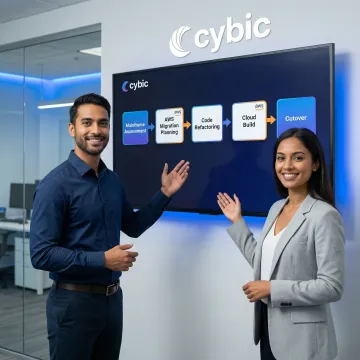
Cybic uses a phased migration approach with parallel-run testing, functional equivalence validation, and incremental cutover strategies ensuring production systems remain fully operational throughout the migration. Critical batch processes, integrations, and data flows are validated against the mainframe baseline before any cutover is executed, minimizing the risk of service disruption.
What languages and mainframe technologies does Cybic support?
Cybic has expertise migrating applications written in COBOL, PL/I, Assembler, and JCL, along with mainframe data stores including VSAM, DB2 for z/OS, and IMS. We handle batch job migration, CICS transaction modernization, and MQ-based messaging re-architecture covering the full breadth of typical enterprise mainframe environments.
How long does a mainframe modernization project typically take?
Timelines vary based on mainframe footprint, code complexity, and the number of applications in scope. A focused workload refactoring engagement can complete in 3–6 months, while full enterprise mainframe exit programs typically span 12–24 months. Cybic's phased roadmap approach allows organizations to realize early cloud benefits while larger workloads are progressively migrated.
How does Cybic handle data migration from mainframe to AWS?
Cybic migrates mainframe-resident data including VSAM files, DB2 z/OS databases, and flat files to AWS-native targets such as Amazon RDS, Aurora, Redshift, and S3 data lakes. We design and validate ETL/ELT pipelines for accurate data transformation, perform data quality checks, and implement governance frameworks to maintain compliance throughout the migration process.
What AWS services does Cybic leverage for mainframe modernization?
Cybic leverages a broad set of AWS services tailored to each workload: AWS BLU Age for automated code refactoring, Amazon ECS and EKS for containerized deployment, AWS Lambda for serverless functions, Amazon RDS and Redshift for data modernization, AWS Step Functions for batch orchestration, and AWS IAM and CloudTrail for security, governance, and auditability.
Does Cybic provide post-migration support and optimization after going live on AWS?
Yes. Cybic provides post-migration monitoring, cost optimization, and performance tuning services following go-live on AWS. We establish CloudWatch-based observability, right-size compute and storage resources, and embed ongoing governance reviews to ensure the modernized environment continues to meet performance, security, and compliance requirements as your business evolves.