Introduction
Most organizations treat cloud adoption as a technology project. You buy the licenses, designate a migration lead, and start moving workloads. Three years later, you're paying 30% more than your on-premises environment cost, security audit findings are piling up, and your infrastructure can't support the AI initiatives your leadership is now prioritizing.
The problem isn't the cloud. It's the absence of intentional infrastructure design.
Intentional infrastructure design means making workload placement, governance, security, performance, and cost decisions deliberately - before they calcify into expensive problems. IT infrastructure consulting for cloud adoption closes that gap: aligning the architecture your organization builds with the business outcomes you're trying to achieve.
This article covers what that consulting discipline looks like: why unguided cloud adoption creates predictable failure patterns, how a structured engagement moves from assessment through execution, the five pillars a sound cloud infrastructure must address, and what separates a genuine engineering partner from a firm that delivers strategy decks.
Key Takeaways
- 79% of enterprises have or are planning multicloud deployments - unmanaged complexity is the norm, not the exception
- Cloud waste is widespread: roughly 28% of cloud spend goes to waste that organizations could avoid
- Skilled infrastructure consultants assess, design, migrate, and govern - covering far more ground than workload migration alone
- Scalable cloud infrastructure is built on five pillars: security, governance, cost discipline, resilience, and elasticity
- The right consulting partner ships working infrastructure, not recommendations documents
Why Unguided Cloud Adoption Fails
The Complexity Is Real
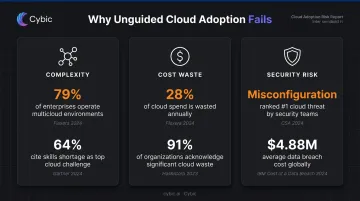
Enterprise cloud environments are rarely simple. According to the 2024 HashiCorp State of Cloud Strategy Survey, 79% of organizations have or are planning multicloud deployments, and 36% are actively expanding multicloud infrastructure.
Managing multiple providers, environments, and governance models simultaneously is difficult by design. Without a deliberate infrastructure strategy, the result is fragmented toolsets, inconsistent policies, and spending that nobody can explain.
The execution gap makes this worse. The same survey found that 64% of organizations report a shortage of skilled staff to support cloud infrastructure objectives. Internal IT teams aren't failing because they're not talented - they're stretched managing daily operations, leaving little capacity for the dependency mapping, capacity planning, and architecture decisions that scalable cloud adoption demands.
The Cost Problem Nobody Talks About
Cloud adoption is frequently sold as a cost-saving move. The numbers tell a different story.
McKinsey's 2025 analysis of over $3 billion in cloud spending found that organizations identify roughly 28% of cloud spend as waste, with most portfolios carrying 10–20% in untapped savings. The HashiCorp survey found 91% of respondents acknowledge wasting cloud money, driven by lack of skills (41%), overprovisioning (40%), and idle resources (35%).
Unguided cloud adoption doesn't eliminate infrastructure costs. It shifts them, hiding waste inside budgets that have no visibility into what they're actually paying for.
Security and Compliance Exposure
Security misconfiguration was ranked the #1 cloud computing threat by the Cloud Security Alliance's 2024 Top Threats report, based on input from over 500 industry experts.
In regulated industries - healthcare (HIPAA), energy (NERC CIP), financial services, public sector (FedRAMP) - compliance requirements are non-negotiable from the first architectural decision. They can't be retrofitted once systems are live.
The average cost of a data breach reached $4.88 million globally in 2024 according to IBM, with regulated industries trending higher. That figure alone makes a compelling case for getting the architecture right the first time.
The Consulting Process: Assessment Through Execution
Phase 1: Infrastructure Assessment and Cloud Readiness
Every credible engagement starts with a current-state audit. Before recommending anything, a consultant needs to understand what exists: workload inventory, application dependency mapping, network architecture, security posture, and regulatory requirements.
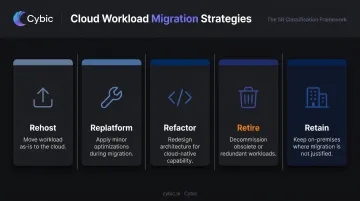
This step prevents organizations from migrating systems that aren't suited for cloud environments without redesign. The output is a workload classification across five categories:
- Rehost - move as-is (lift and shift)
- Replatform - minor optimization before migration
- Refactor - significant redesign for cloud-native operation
- Retire - decommission, no migration needed
- Retain - keep on-premises for now
Skipping this phase is one of the most reliable warning signs that a consulting engagement will struggle. Without it, teams make architecture decisions on incomplete information - and those gaps surface later as migration failures, cost overruns, or security gaps.
Phase 2: Architecture Design and Cloud Model Selection
Architecture design translates business requirements into infrastructure decisions. Some workloads belong in public cloud; others require private or on-premises hosting due to data residency or latency constraints. The right model - hybrid, multicloud, or single-provider - depends on the organization's compliance needs and vendor strategy, not on what a preferred vendor offers.
Building across AWS, Azure, and GCP without creating lock-in is the mark of infrastructure-agnostic design done well.
Key decisions made at this stage:
- Identity and access management architecture
- Network topology and segmentation
- Compute and storage tier selection
- Disaster recovery architecture and RTO/RPO targets
- Observability and monitoring framework design
Phase 3: Migration Execution and Validation
Moving workloads is where most of the visible risk sits. Rigorous execution requires:
- Phased rollouts rather than big-bang cutovers
- Pilot migrations before full-scale deployment
- Defined validation checkpoints at each stage
- Rollback plans that have been tested, not just documented
Post-migration validation matters too - confirming performance, security controls, and integration integrity before declaring success. Organizations that skip validation often discover problems under production load that are far more expensive to fix than they would have been to prevent.
Phase 4: Ongoing Governance, Optimization, and AI Readiness
Cloud infrastructure isn't a project with a finish line. After migration, ongoing governance includes cost monitoring, rightsizing, policy enforcement, security patching, and performance tuning.
Organizations in manufacturing, healthcare, energy, and financial services face a compounding challenge: their cloud environments also need to support AI workloads - data pipelines, ML model serving, agentic systems - without expensive retrofitting later. Cybic addresses this by embedding AI readiness at the architectural level during the design phase, not as a bolt-on after migration is complete.
The Five Pillars of Scalable Cloud Infrastructure
Pillar 1 - Scalability by Design
Cloud platforms don't automatically provide scalability. It must be engineered into the architecture through:
- Clean workload separation with defined service boundaries
- Auto-scaling policies tied to actual demand patterns
- Load balancing across compute and application tiers
- Modular architecture using containers and microservices
- Capacity planning based on real business growth projections
Scalability failures under load are almost always traceable to architectural shortcuts made during initial deployment.
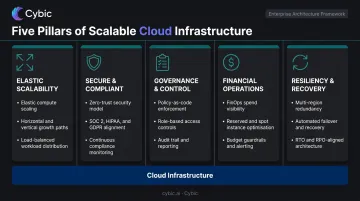
Pillar 2 - Security and Compliance
Security controls must be embedded across the entire infrastructure stack before systems go live - not retrofitted after. Core requirements include:
- Encryption in transit and at rest
- Multi-factor authentication and identity and access management
- Network segmentation
- Continuous threat monitoring
For regulated environments, compliance frameworks (HIPAA, SOC 2, GDPR, FedRAMP, NERC CIP) dictate specific technical controls that must be reflected in the architecture from day one. HHS guidance on HIPAA and cloud computing makes clear that covered entities must conduct risk analyses and ensure authorized-access controls are implemented in cloud resources - obligations that can't be met by a governance layer bolted on after deployment.
Pillar 3 - Governance by Design
Governance isn't a policy document. It's role-based access controls, data classification policies, auditability of automated and AI-driven actions, and regulatory traceability - built into the architecture at the foundation level.
This matters particularly for enterprises deploying AI and automation systems. When automated workflows make decisions or trigger actions, the infrastructure must support full audit trails and access controls that satisfy both internal oversight and external compliance requirements. Cybic builds governance into cloud infrastructure engagements at this level - RBAC, encrypted data protection, and traceability of AI-driven actions are structural elements, not optional add-ons.
Pillar 4 - Cost Discipline and FinOps
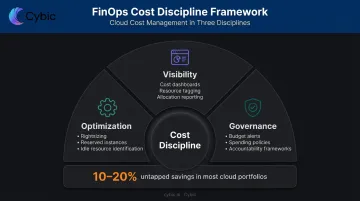
Governance without cost discipline creates a different kind of risk: runaway cloud spend. Controlling costs requires visibility, optimization, and accountability working together:
- Visibility - cost dashboards, resource tagging, and allocation reporting by team or workload
- Optimization - rightsizing recommendations, reserved instance planning, and identifying idle resources
- Governance - budget alerts, spending policies, and accountability frameworks
McKinsey estimates that most organizations carry 10–20% in untapped cloud savings. The FinOps Foundation's 2024 State of FinOps survey found that reducing waste (60%) and managing commitments (54%) were the top two priorities for FinOps teams - a signal that most enterprises are still in the early stages of cost maturity.
Pillar 5 - Resilience and Continuity
Well-designed cloud infrastructure accounts for failure as a baseline assumption. This means:
- Redundant availability zones with automated failover
- Defined RTO (Recovery Time Objective) and RPO (Recovery Point Objective) targets per workload - not a single universal target, but workload-specific values determined through business impact analysis
- Backup and disaster recovery plans that have been tested, not just documented
- Workload distribution across regions or providers for mission-critical systems
NIST SP 800-34 establishes the standard for contingency planning, requiring organizations to define Maximum Tolerable Downtime, RTO, and RPO for each mission-critical process. Without those defined thresholds, recovery decisions get made under pressure with no agreed baseline - which is precisely when the absence of planning costs the most.
What to Look for in a Consulting Partner
A consulting partner's job isn't to sell you a platform - it's to design the right architecture for your organization, whatever platform that requires. That distinction matters most when your workloads span compliance-heavy environments where a vendor's incentives and your operational needs rarely align.
Evaluate on these criteria:
- Proven delivery track record in your specific industry and regulatory environment
- Ability to design across AWS, Azure, GCP, and hybrid environments without favoring one
- Security and governance embedded at the architecture level, not presented as optional scope
- Engineering execution alongside strategic guidance - working systems, not just recommendations
- Experience with your sector's specific compliance requirements (HIPAA, FedRAMP, NERC CIP, SOC 2, GDPR)
- Willingness to integrate with your existing infrastructure and internal teams without displacing them
Watch for these warning signs:
- Skipping the infrastructure assessment phase and going straight to recommendations
- Proposing the same cloud model regardless of workload type or compliance context
- Treating security and compliance as separate, add-on work items
- Engagements that conclude with a roadmap document rather than implemented systems
- Vendor affiliations that drive architecture recommendations
A partner that clears these criteria will look roughly like this in practice: they start with your workloads, your compliance constraints, and your existing infrastructure - then determine the architecture. Cybic operates across AWS, Azure, and Google Cloud on that basis, with architecture decisions shaped by operational requirements, compliance obligations, and scalability needs specific to each engagement.
Frequently Asked Questions
What does an IT infrastructure consultant actually do during cloud adoption?
An IT infrastructure consultant assesses the current environment, designs the cloud architecture, plans and executes migration, and establishes governance and optimization frameworks. The role spans both strategic advisory and hands-on engineering - covering the full engagement, not just a single phase.
How is IT infrastructure consulting different from cloud migration services?
Cloud migration covers one phase: moving workloads to the cloud. IT infrastructure consulting is broader, spanning readiness assessment, architecture design, security and governance frameworks, migration execution, and ongoing optimization aligned to business goals.
What cloud deployment model is best for enterprise scalability?
It depends on workload type, compliance requirements, and operational priorities. Many enterprises benefit from hybrid or multicloud approaches, but the right model should be determined by an infrastructure assessment - not vendor preference or industry defaults.
How do I know if my current IT infrastructure is ready for cloud adoption?
A cloud readiness assessment evaluates your existing workloads, application dependencies, security posture, and regulatory requirements. It identifies which systems are cloud-ready and which need redesign or remediation before migration begins.
How long does an IT infrastructure consulting engagement typically take?
A focused assessment and architecture design phase typically takes 4–8 weeks. Full enterprise migration and governance implementation typically spans several months, depending on scope, workload complexity, and phasing requirements.
How should security and compliance be handled during cloud infrastructure design?
Security and compliance must be embedded at the architecture level from the start. Identity controls, encryption, network segmentation, and regulatory framework alignment should all be incorporated before systems are deployed - not retrofitted afterward.