Introduction
Enterprise organizations face a critical tension: data volumes are exploding, but the legacy on-premises warehouses built to handle them designed for a different era that can't keep up. They're too slow to support real-time analytics, too rigid to accommodate AI workloads, and too costly to justify when faster alternatives exist. According to Gartner (2024), companies spend an average of 70% of their IT budgets on routine maintenance, leaving less than 30% for innovation. This financial burden creates a cycle where organizations can't invest in the capabilities such as AI, machine learning, real-time analytics that would separate them from faster-moving competitors.
Data warehouse modernization on AWS is the shift from monolithic on-premises architecture to a cloud-native, modular data infrastructure built on services like Amazon Redshift, S3, and AWS Glue. The practical differences from legacy systems are significant:
- Elastic infrastructure: Compute and storage scale independently on demand, no hardware procurement cycles
- Real-time ingestion: Cloud-native services eliminate the lag that batch ETL pipelines create between data generation and business insight
- Open data layers: AWS supports open, accessible formats that integrate directly with modern BI tools and AI frameworks
This guide is for IT leaders, data engineers, and cloud architects evaluating or planning a migration from legacy systems like Teradata, Oracle, SQL Server to AWS. You'll come away understanding why legacy warehouses are failing, which AWS services power modernization, how to execute a phased migration, and how to build a governed, AI-ready data architecture that delivers measurable outcomes.
TLDR: Key Takeaways
- Legacy warehouses create cost drag, rigid pipelines, and architectural limits that block real-time analytics and AI
- Amazon Redshift delivers massively parallel processing (MPP), columnar storage, and native S3 integration for petabyte-scale analytics
- AWS modernization follows a phased approach: assess, architect, migrate, test, and optimize, reducing risk and building team confidence
- Post-migration, your data infrastructure becomes the foundation for AI, ML, and intelligent automation
- Governance, security, and access controls must be embedded at the architecture level, not added as an afterthought
Why Legacy Data Warehouses Are Failing Modern Business Demands
Architectural Rigidity and the Cost of Tightly Coupled Systems
Traditional on-premises data warehouses use tightly coupled compute and storage, meaning any increase in data volume requires expensive hardware procurement that also forces over-provisioning. If your data grows by 30%, you can't just add storage, you must purchase additional compute capacity, networking infrastructure, and often upgrade the entire appliance.
This creates a capital expenditure (CapEx) cycle where organizations pay upfront for capacity they won't use for months or years, while lacking the flexibility to scale down during slower periods.
Contrast this with AWS's elastic, pay-as-you-go model. Amazon Redshift separates compute and storage, allowing you to scale each independently. Need more storage for historical data? Add S3 capacity at pennies per gigabyte without touching compute. Need more processing power for quarterly reporting? Scale up Redshift compute nodes for those specific workloads, then scale back down. You pay only for what you use, eliminating both over-provisioning waste and under-provisioning performance degradation.
The ETL Bottleneck and Real-Time Analytics Gap
Legacy warehouses rely on long-running batch ETL processes that are slow to adapt to new data types like streaming data, semi-structured JSON, IoT sensor data, voice transcripts. These systems were designed for nightly batch loads from structured relational databases, not for the continuous, high-velocity data streams that modern businesses generate.
This creates lag between data generation and business insight, a critical problem for industries where real-time decisions matter:
- Retail: The global retail industry loses $1.73 trillion annually to inventory distortion (out-of-stocks and overstocks). Batch processing prevents dynamic pricing and real-time inventory visibility.
- Financial Services: Identity fraud losses reached $27.2 billion in 2024. Traditional batch systems increase analysis-to-action latency, preventing real-time fraud detection.
- Oil & Gas: Analysis-to-action latency in traditional systems can stretch to 32 hours, resulting in lost revenue, regulatory exposure, and compounding equipment damage.

AWS addresses this through services like Amazon Kinesis for real-time data ingestion, AWS Glue for serverless ETL, and Redshift's continuous data loading capabilities enabling organizations to analyze data within minutes of generation, not hours or days later.
The Financial Burden of Legacy Maintenance
Maintaining legacy data warehouses introduces growing financial and operational burdens beyond the initial license costs:
| Legacy Platform | Primary Cost Drivers |
|---|---|
| Oracle (Exadata/DW) | Annual support fees consume 22% of upfront license cost, with yearly increases typically ranging from 4% to 8% |
| Microsoft SQL Server | Enterprise Edition core licenses cost $15,123 per 2-core pack (minimum 8 cores per server = $60,492 base), plus 25-35% annually for Software Assurance |
| Teradata | Hardware support lifecycles force expensive upgrades; remedial maintenance provided for only 6 years from platform sales discontinuation |
| DBA Talent Scarcity | Fully loaded cost of a senior SQL Server DBA ranges from $186,000 to $258,000+ annually, making specialized talent expensive to acquire and retain |
These costs compound over time without delivering proportional increases in analytical capabilities. Organizations trapped in this cycle spend the majority of their IT budgets maintaining existing infrastructure rather than building new capabilities that drive revenue or competitive advantage.
The Analytics Ceiling and AI Readiness Gap
Legacy warehouses lock data into proprietary formats, making it difficult for modern BI tools, data science notebooks, or AI/ML frameworks to access data without costly, custom connectors. This directly limits an organization's ability to build predictive models or AI-driven workflows.
When data scientists need to build a churn prediction model, they can't simply query the warehouse, they must extract data, transform it into a compatible format, move it to a separate analytics environment, then maintain a complex pipeline to keep the model updated. This friction means AI initiatives stall in proof-of-concept phases rather than reaching production deployment.
AWS closes this gap through native integrations between Redshift, Amazon SageMaker (for ML model development), and Redshift ML (for in-database predictions). Data scientists can train models using SQL commands, and predictions become available as standard SQL functions without data movement, custom connectors, or the friction that stalls production deployment.
The Tipping Point: Why Modernization Is Now Business-Critical
The convergence of cloud maturity, AI demand, and competitive pressure has turned data warehouse modernization from a "nice to have" into a business-critical priority. IDC (2024) projects that more than two-thirds of production workloads will shift to the cloud over the next 3 to 5 years, driven by organizations seeking the agility, cost efficiency, and AI capabilities that on-premises infrastructure simply cannot deliver.
Organizations that delay modernization face compounding disadvantages:
- Escalating maintenance costs that crowd out investment in new capabilities
- No path to real-time analytics on legacy batch architectures
- Competitive exposure as cloud-native rivals move faster on AI
- AI/ML deployment blocked by proprietary data formats and missing integrations
Key AWS Services That Power Data Warehouse Modernization
Amazon Redshift: The Core Cloud-Native Data Warehouse
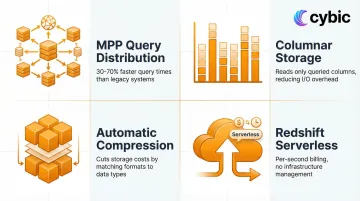
Amazon Redshift is AWS's flagship cloud-native data warehouse, built for high performance through Massively Parallel Processing (MPP) architecture and columnar data storage. Unlike row-based legacy systems that read entire records even when queries need only a few columns, Redshift reads only the specific columns required, which cuts I/O overhead and accelerates query performance considerably.
Key Redshift capabilities:
- Distributes query execution across multiple nodes via MPP, delivering 30-70% faster query times than legacy systems
- Stores data by column rather than row, so analytical queries that aggregate specific fields skip irrelevant data entirely
- Automatically applies compression formats matched to each column's data type, cutting storage costs alongside query time
- Redshift Serverless provisions and scales capacity on demand, charging only for compute consumed per second making enterprise analytics accessible for teams without dedicated infrastructure management
Conclusion
Data warehouse modernization on AWS is not simply a technology refresh - it is a structural shift that repositions your data infrastructure as a strategic business asset. Legacy systems built around tightly coupled compute and storage, batch ETL pipelines, and proprietary formats cannot support the speed, scale, or analytical depth that modern enterprises require. The cost of staying on them compounds every year: growing maintenance spend, widening real-time analytics gaps, and an increasingly hard ceiling on what your data can do.
A cloud-native architecture built on Amazon Redshift, S3, AWS Glue, Kinesis, and Athena eliminates these constraints. Compute and storage scale independently. Data moves from source to insight in minutes rather than hours. Open formats let every downstream tool - BI platforms, data science notebooks, and orchestration engines - work directly against the same governed data layer without custom connectors or brittle pipelines.
The migration itself is not a single-step event. A phased approach - assess, architect, migrate, test, optimize - distributes risk, builds team confidence, and delivers measurable value at each stage rather than deferring all returns to a distant go-live date. Governance and security controls embedded at the architectural level, not added afterward, ensure that the data your teams depend on is accurate, auditable, and access-controlled from day one.
Beyond operational efficiency, the modernized AWS data stack is the prerequisite for everything that comes next. Clean, governed, scalable data is what makes ML pipelines reliable, AI copilots trustworthy, and intelligent automation safe to deploy at scale. Organizations that complete this foundation are not just running faster on the same track - they are positioned to build entirely new capabilities around machine learning, predictive analytics, and enterprise AI workloads that were structurally impossible on legacy infrastructure. The data warehouse modernization journey, done right, ends with an architecture that is not just built for today's analytics demands but ready for tomorrow's AI-driven business.
Frequently Asked Questions
Why do legacy data warehouses struggle to meet modern business demands?
Legacy warehouses couple compute and storage into a single appliance, forcing expensive hardware upgrades whenever data volumes grow and making independent scaling impossible. Their batch ETL pipelines introduce hours of lag between data generation and business insight, and their proprietary formats block direct integration with modern BI tools, data science environments, and AI frameworks. The combined result is a system that consumes the majority of IT budgets on maintenance while delivering diminishing analytical value.
Which AWS services are central to a modernized data warehouse architecture?
Amazon Redshift is the core analytical engine, providing MPP columnar processing, native S3 integration, and Redshift Serverless for on-demand capacity. Amazon S3 forms the open data lake layer, storing raw and processed data in formats accessible to any downstream tool. AWS Glue handles serverless ETL and data cataloging, Amazon Kinesis enables real-time data ingestion from streaming sources, and Amazon Athena delivers serverless SQL querying directly against S3 without data movement. Together these services form a modular, elastic architecture where each layer can be scaled and optimized independently.
How do you choose between a lift-and-shift migration and a full re-architecture on AWS?
Lift-and-shift - moving existing workloads to cloud infrastructure with minimal changes - delivers faster time-to-cloud and lower initial complexity, but it preserves the same architectural constraints that make legacy systems expensive and slow to evolve. A full re-architecture redesigns data flows around cloud-native services, unlocking independent scalability, real-time ingestion, and open data formats, but it requires more planning and carries higher short-term execution risk. Most enterprise migrations follow a phased hybrid approach: migrate the most critical or least complex workloads first using lift-and-shift to establish a baseline, then progressively re-architect higher-value pipelines and data domains as the team builds cloud-native expertise.
How do you maintain data governance and quality on AWS after migration?
Governance on AWS is most effective when it is embedded at the architectural level rather than enforced after the fact. AWS Glue Data Catalog provides a centralized metadata repository that tracks schema definitions, data lineage, and ownership across all datasets. AWS Lake Formation enables fine-grained access controls and row- and column-level security on top of S3 data. For data quality, validation rules applied at the staging layer - before data reaches the analytical zone - prevent bad records from propagating downstream into reports and models. Combining automated quality checks, role-based access controls, and audit logging from the initial architecture design produces a governed data environment that scales without requiring manual oversight at every layer.
What does a realistic data warehouse migration timeline look like?
Timeline varies significantly based on data volume, source system complexity, and the number of downstream consumers that need to be reconnected after migration. A straightforward migration from a single on-premises warehouse with well-documented schemas typically spans three to six months across assessment, architecture design, migration execution, and validation. Complex environments involving multiple legacy platforms, undocumented schemas, and dozens of dependent BI reports or ETL jobs commonly run twelve to eighteen months when executed in phases. The phased approach - migrating workloads in prioritized batches rather than all at once - consistently reduces risk and allows teams to validate each stage before proceeding, even if the overall calendar extends slightly.
How does a modernized AWS data warehouse enable AI and ML workloads?
A cloud-native data warehouse removes the three barriers that most commonly stall AI initiatives in organizations running legacy infrastructure: data accessibility, data quality, and compute elasticity. When data lives in open formats on S3 with governed access controls and validated quality at the staging layer, ML engineers can train models directly against production data without building custom extraction pipelines or maintaining separate analytical copies. Redshift's native integration with machine learning services means predictions can be generated as standard SQL functions inside the warehouse itself, eliminating the round-trip latency of moving data to an external scoring environment. The elastic compute model ensures that training and inference workloads can scale on demand without contending for resources with operational reporting - making it practical to run AI workloads continuously rather than in constrained off-peak windows.