What are cloud migration services?
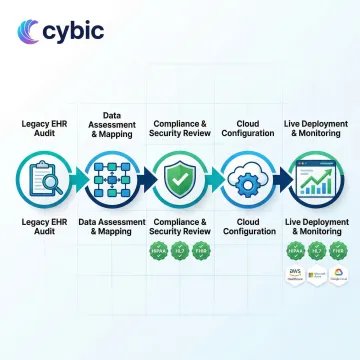
Cloud migration services involve moving an organization's digital assets including applications, databases, workloads, and infrastructure from on-premises or legacy environments to cloud platforms like AWS, Azure, or Google Cloud. For healthcare, this includes migrating EHR systems, clinical data pipelines, and patient records while maintaining HIPAA compliance, data integrity, and zero disruption to care delivery operations.
Is healthcare cloud migration HIPAA compliant?
Yes, when executed correctly. At Cybic, HIPAA compliance controls including data encryption at rest and in transit, role-based access controls (RBAC), audit trails, and business associate agreement (BAA) alignment are built into the cloud architecture from day one. Compliance is treated as a design requirement, not an afterthought, ensuring your environment meets regulatory obligations throughout the migration and beyond.
How long does a healthcare cloud migration take?
Migration timelines vary based on the complexity of your existing infrastructure, the volume of sensitive data, and the number of integrated clinical systems. A focused migration of a single application can take 6-12 weeks, while enterprise-wide EHR and data warehouse migrations typically span 3-9 months. Cybic conducts a thorough discovery assessment upfront to provide a realistic, phased project timeline.
Will clinical operations be disrupted during migration?
Minimizing clinical downtime is a core design principle of every Cybic migration. We execute phased migration plans with rollback protocols, parallel-run periods, and rigorous integration validation testing ensuring patient-critical systems, EHR platforms, and clinical workflows remain operational throughout every stage of the migration process.
Which cloud platforms do you support for healthcare migrations?
Cybic supports multi-cloud and hybrid migrations across AWS, Microsoft Azure, and Google Cloud. We also specialize in modern data platform migrations involving Snowflake and Databricks for healthcare data warehousing. Our architecture is infrastructure-agnostic, meaning we recommend and build on the platform best suited to your clinical, regulatory, and operational requirements without locking you into a single vendor.
How is patient data protected during migration?
All data in transit and at rest is protected using enterprise-grade encryption. Cybic's migration architecture includes strict data governance controls, role-based access permissions, no use of proprietary patient data for model training, and comprehensive auditability of all data movements. These safeguards ensure patient privacy is maintained at every stage of the migration process, fully aligned with HIPAA and GDPR requirements.
Can you migrate legacy EHR systems to the cloud?
Yes. Legacy EHR and clinical system modernization is a core component of Cybic's healthcare cloud migration service. We re-engineer outdated applications, migrate workflows, rebuild API integrations, and transition legacy data stores to modern cloud architectures, all without disrupting the clinical operations that depend on them. This includes supporting interoperability standards like HL7 and FHIR where applicable.
What ongoing support is provided after the migration is complete?
Cybic's engagement doesn't end at go-live. Post-migration, we provide governance enablement including monitoring frameworks, access control reviews, performance optimization, and compliance auditing. We ensure your cloud environment remains operationally healthy, regulatory-aligned, and continuously optimized as your healthcare organization's data volumes and clinical needs evolve over time.