Introduction
Most CEOs have approved at least one AI initiative. Far fewer have transformed their organizations with AI. That gap is almost never a technology problem. It's a leadership one.
Gartner predicted in 2024 that at least 30% of generative AI projects would be abandoned after proof of concept by end of 2025, citing poor data quality, inadequate risk controls, escalating costs, and unclear business value. The broader picture is worse: RAND research notes that by some estimates, more than 80% of AI projects fail - roughly twice the rate of non-AI IT projects.
The difference between organizations that scale AI and those that accumulate expensive pilots almost always traces back to the same source: who owns the strategy.
This guide is written for CEOs - those accountable for competitive positioning, capital allocation, and organizational change, not for those managing a technology roadmap. It covers how to build a defensible AI strategy, close the gap from pilot to production, govern AI responsibly, and measure outcomes that move the business.
Key Takeaways
- AI strategy must be CEO-led: it touches every function, budget, and workforce decision in your organization
- Start with your highest-impact business problems; AI use cases should follow strategy, not lead it
- BCG's 10-20-70 rule: 70% of AI success comes from people and process change - not the technology itself
- Governance, data readiness, and security must be resolved before implementation begins
- The biggest competitive advantage is speed from pilot to production, not having the most advanced models
Why CEOs Must Own the AI Strategy - Not Delegate It
The Leadership Gap Behind AI Failures
When AI initiatives fail, the root cause is rarely the model. It's the decisions made before the model was ever built: which workflows to target, how much to invest, how fast to move, and who owns the outcome. Those are business decisions. They require CEO-level authority, cross-functional visibility, and the willingness to make tradeoffs that a data science team cannot make on its own.
Delegating AI strategy entirely to a CTO or analytics team creates a structural problem. Technical teams optimize for what's buildable. CEOs must optimize for what's valuable - and those are different questions with different answers.
The Competitive Pressure Is Already Here
The business case for urgency is real. McKinsey estimated in 2023 that generative AI could add $2.6 trillion to $4.4 trillion annually across 63 use cases. By 2025, 71% of organizations reported regularly using generative AI in at least one business function.
The adoption curve has passed the early-adopter stage. The competitive question now is not whether to adopt AI, but how fast you can move from experimentation to operational advantage.
Manufacturing peers are compressing lead times. Healthcare systems are reducing administrative costs. Retailers are narrowing forecast errors. The risk of moving too slowly is real, and so is the risk of moving without governance. Both fears are legitimate - and both point to the same requirement: a strategy with clear definitions, ownership, and sequencing.
That starts with a distinction most executive teams skip.
Experimentation vs. Transformation
There's a critical distinction CEOs must make before allocating a dollar:
- AI experimentation - running pilots, testing capabilities, building organizational familiarity
- AI transformation - embedding AI into core operations, changing how decisions get made, and aligning workflows around AI outputs
They require different funding, different timelines, and different success criteria. CEOs who conflate them end up with a portfolio of promising pilots and no production systems.
The CEO's Framework for Building an AI Strategy
Start with business outcomes, not technology choices. The sequence matters: business problem first, use case second, technology third. Invert this order and you get an expensive pilot that never scales.
Identify High-Impact Use Cases Tied to Strategic Priorities
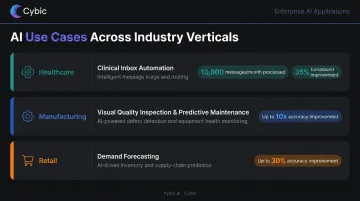
The goal is to find two or three business domains where AI can deliver measurable value against metrics you already track. Some concrete examples across Cybic's target verticals:
- Healthcare - Clinical inbox and workflow automation. Providence's deployment of Azure OpenAI processed roughly 10,000 messages per month with a 35% improvement in turnaround time. Revenue cycle AI could reduce cost to collect by 30–60%, according to McKinsey's 2025 analysis.
- Manufacturing - AI-powered quality inspection and predictive maintenance. Google Cloud's Visual Inspection AI customers improved production-trial accuracy by up to 10x compared with general-purpose ML approaches. Cybic builds predictive maintenance and asset monitoring systems for manufacturers targeting similar reductions in unplanned downtime.
- Retail - Demand forecasting and inventory optimization. AI forecasting models have demonstrated accuracy improvements of up to 30% in retail settings, directly reducing overstock and stockout costs.
Prioritize use cases where failure is recoverable and early wins can build internal confidence. A clinical scheduling optimization that underperforms is fixable. An AI system embedded in high-stakes financial decisions, launched without proper validation, is not.
Assess AI Readiness Before You Invest
Skipping a readiness assessment is one of the most common reasons AI investments underdeliver. Before committing budget, evaluate:
- Data quality and accessibility: Is the data you need clean, labeled, and reachable by the systems that will use it?
- Infrastructure: Cloud, on-prem, or hybrid? What integration complexity exists with your current systems?
- Internal skills: Do you have the people to build, deploy, and maintain AI systems, or do you need to partner externally?
- Workflow integration complexity: How deeply embedded are the processes AI will touch? High complexity demands more change management, not just more engineering.
Cybic's consulting engagements include formal AI readiness assessments that evaluate data landscape gaps, infrastructure architecture, and integration complexity - the practical inputs a CEO needs to make a well-grounded investment decision.
Apply BCG's 10-20-70 Rule to Your Budget
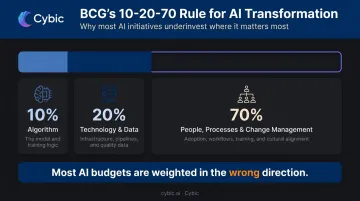
Readiness findings directly shape where your budget needs to go. BCG's research on AI transformation makes this distribution explicit: 10% of AI success comes from the algorithm, 20% from technology and data, and 70% from people, processes, and change management. That ratio has a direct implication for how CEOs should allocate resources.
If your AI budget is weighted heavily toward model development and infrastructure, you are underfunding the factor that determines whether the technology gets adopted. Budget accordingly - change management, workflow redesign, and training are not soft costs. They are where the majority of value gets created or lost.
Set Clear Objectives, Owners, and Success Metrics
Every AI initiative needs three things before it starts:
- A business owner: not a technical lead, but the person accountable for the business outcome
- A defined success metric tied to a KPI that already matters (cost per claim, defect rate, forecast accuracy, time-to-resolution)
- A realistic timeline with defined checkpoints
Without this structure, AI projects drift into indefinite experimentation. The pilot never officially fails. It just never ends.
From Pilot to Production: Closing the AI Execution Gap
The Pilot Trap
The pattern is familiar: a proof of concept succeeds, stakeholders are impressed, and then... the project stalls. Months pass. The pilot never becomes a product. Gartner's data on the 30% abandonment rate after proof of concept reflects exactly this dynamic.
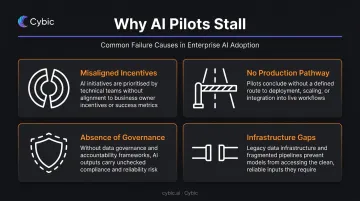
Why does it happen? Four consistent reasons:
- Misaligned incentives - technical teams are rewarded for building something that works in a sandbox, not for operational adoption
- No production pathway - the pilot was designed to demonstrate capability, not to integrate with real systems
- Absence of governance - no one owns the decision of what happens when the model behaves unexpectedly
- Infrastructure gaps - the data pipelines, monitoring systems, and integration work needed for production were never scoped or funded
What Production Actually Requires
Moving from pilot to production is an engineering problem, not a strategy problem. It requires:
- Integration with existing systems and workflows (ERP, CRM, EMR, SCADA - whatever the business runs on)
- Data pipelines built for real-time or near-real-time use, not batch exports prepared for a demo
- Operational support: monitoring, model retraining schedules, and incident response
- Cross-functional adoption - training, change management, and workflow redesign for the people who will use the system daily
Most pilots stall precisely because no single team owns all four of these layers. Cybic's engineering-led delivery model is built to close this gap. The same team that designs the system also builds and integrates it directly into the client's operational environment. This eliminates the hand-off problem between strategy and execution that causes most pilots to stall.
The Infrastructure Question CEOs Overlook
Cloud, on-premises, or hybrid? The right answer depends on:
- Regulatory requirements - healthcare and financial services often require on-prem or private cloud for certain data categories
- Data sensitivity - proprietary operational data may not belong in a public cloud training environment
- Latency needs - real-time manufacturing or energy monitoring often requires edge or on-prem processing
The right infrastructure answer should come from your requirements, not from a vendor's preferred deployment model. Locking into a single cloud ecosystem early limits flexibility as those requirements evolve. Cybic's infrastructure-agnostic architecture spans AWS, Azure, and Google Cloud, and is designed to operate across cloud, hybrid, or on-prem environments without tying organizations to a single provider.
Building an AI-Ready Organization: Culture, Talent, and Governance
The Culture Dimension
Technical readiness without cultural readiness produces adoption failure. Employees need to understand how AI changes their roles - not eliminates them. CEOs who communicate this clearly, and who visibly model AI adoption themselves, cut the resistance that derails otherwise solid implementations.
The CEO's job is to set the narrative before someone else does. When AI is introduced without a clear leadership message, employees fill the gap with their own assumptions - and those assumptions are rarely optimistic.
Closing the Talent Gap
Culture shifts expose a harder problem: the people capable of building and running AI systems are in short supply. The numbers are blunt. IBM's 2024 Global AI Adoption Index found that 52% of IT professionals cited lack of skills and training to develop and manage trustworthy AI as a significant barrier, and 33% named limited AI skills as a primary adoption obstacle. The World Economic Forum's 2025 Future of Jobs Report found that 63% of employers identified skill gaps as the biggest barrier to business transformation overall.
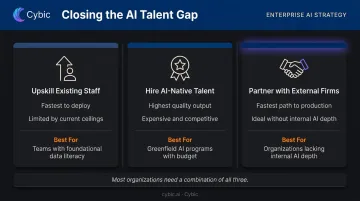
CEOs have three realistic options - and most need a combination of all three:
- Upskill existing staff - faster to deploy, but limited by current capability ceilings
- Hire AI-native talent - expensive and highly competitive; machine learning engineers are among the hardest roles to fill in enterprise technology
- Partner with external engineering firms - fastest path to production for organizations without deep internal AI capability
Governance Structures That Enable Adoption
Organizational AI governance requires more than a policy document. Effective structures include:
- A cross-functional AI steering committee with representation from legal, operations, HR, IT, and the relevant business unit
- A clear escalation path for AI-related decisions, especially when model behavior is unexpected or outcomes are contested
- A responsible use policy covering acceptable AI use by employees, vendors, and automated systems - including how outputs are reviewed before they influence decisions
Governing AI Responsibly: Security, Compliance, and Ethics
Governance as Risk Management
AI governance is a strategic risk management function, not a compliance formality. CEOs must ensure AI systems are auditable, that decisions can be traced and explained, and that sensitive data is protected. Skipping these controls creates compounding exposure: regulatory penalties, reputational damage, and operational failure can arrive at the same time.
What Governance-by-Design Looks Like
The most defensible AI deployments embed governance at the architectural level, not as a post-deployment layer. Key controls that should be non-negotiable in any enterprise AI deployment:
- Enforce role-based access controls (RBAC) defining who can access what data and under what conditions
- Encrypt all data in transit and at rest without exception
- Prevent model training on proprietary enterprise data unless explicit consent and technical controls are in place
- Maintain audit trails so every significant AI-driven decision can be traced and explained
Cybic's Drava platform is built on this design philosophy. Security controls, RBAC, audit trails, and compliance alignment with SOC 2, HIPAA, ISO, and GDPR are embedded at the architecture level across every deployment, built in from the start rather than bolted on afterward.
The Regulatory Landscape CEOs Must Monitor
Regulatory pressure is no longer advisory - enforcement timelines are set and obligations are sector-specific. The frameworks most relevant to enterprise AI deployments:
- EU AI Act: Enforcement is phased. Prohibitions and AI literacy requirements took effect February 2, 2025. GPAI and governance rules apply from August 2, 2025. Most Annex III high-risk obligations - including AI in medical devices, clinical decision support, critical energy infrastructure, and credit scoring - take effect August 2, 2026.
- Healthcare (US): HIPAA covers any AI system processing protected health information. The ONC's HTI-1 Final Rule adds transparency requirements for AI and predictive algorithms embedded in certified health IT systems.
- NIST AI RMF 1.0: The most practical cross-sector starting point for enterprises without sector-specific mandates. Organized around four functions - Govern, Map, Measure, and Manage - it provides a voluntary but widely adopted governance baseline.
Measuring AI ROI and Scaling What Works
A Three-Dimensional ROI Framework
Measuring AI ROI at the initiative level - over a short horizon - produces misleading conclusions. Deloitte's research found that 85% of organizations increased AI investment and 91% planned further increases, yet only 6% reported payback within one year. Most AI portfolios have longer payback curves, and single-pilot measurement rarely reflects that reality.
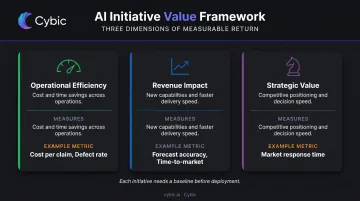
The more useful framework measures AI value across three dimensions:
| Dimension | What It Measures | Example Metric |
|---|---|---|
| Operational efficiency | Cost and time savings from automation | Cost per claim processed, defect rate, turnaround time |
| Revenue impact | New capabilities or faster delivery cycles | Forecast accuracy improvement, time-to-market reduction |
| Strategic value | Competitive positioning, decision speed | Market response time, data-driven decision percentage |
Each initiative needs a baseline measurement before deployment, a target metric, and a defined measurement cadence. Without these in place, you lose the ability to evaluate whether a system is delivering value or just consuming resources.
Scaling Discipline
When measurement confirms that a use case is working, the next decision is replication - and that requires more than declaring success. The CEO's job is to create the organizational conditions that make scaling possible. That means funding:
- Standardized data pipelines that other business units can access and use
- Shared infrastructure that reduces the cost of the next deployment
- Documented processes that allow consistent implementation without starting from scratch each time
- A governance model designed to scale with the number of deployed systems
This is investment work, not enthusiasm work. Scaling without funding the infrastructure for it produces a second wave of pilot-trap failures.
Frequently Asked Questions
What is the 10-20-70 rule for AI strategy?
BCG's 10-20-70 rule states that approximately 10% of AI transformation value comes from the algorithm itself, 20% from technology and data infrastructure, and 70% from people, processes, and organizational change management. The practical implication: most AI budgets are weighted in the wrong direction.
How much does AI strategy consulting cost?
Costs vary significantly by scope - focused readiness assessments typically run in the tens of thousands of dollars, while enterprise-wide transformation engagements can reach into the millions. Cost should be evaluated relative to the business value targeted, not as a standalone expense line.
What is the biggest mistake CEOs make when implementing AI?
The most common mistake is delegating AI strategy entirely to IT or data science teams without CEO-level ownership of business objectives, governance, and change management. The result is technically functional pilots that never achieve organizational scale because the business and cultural conditions for adoption were never created.
How long does AI transformation typically take?
A meaningful first use case can reach production in 3–6 months with the right engineering partner and data infrastructure. Enterprise-wide transformation typically unfolds over 18–36 months in phases, with early wins funding and informing subsequent stages.
How do CEOs measure the ROI of AI investments?
ROI should be measured across three dimensions: operational efficiency (cost and time savings), revenue impact (new capabilities or faster time-to-market), and strategic value (competitive positioning). Each initiative needs a baseline, a target metric, and a measurement cadence established before deployment, not retrofitted afterward.
What is the difference between an AI strategy and an AI roadmap?
An AI strategy defines the "why" and "where": which business outcomes AI will drive and in which domains. An AI roadmap covers the "how" and "when" - the sequenced plan of use cases, investments, and milestones that operationalizes the strategy. You need both, in that order.