The staffing picture compounds the problem. Front office turnover hit 40% in 2022, making it harder to scale manual exception handling as claim volumes grow.
Traditional RPA has provided some relief, but it was never designed for the complexity of modern claims. Agentic AI represents a genuine architectural shift - systems that reason, coordinate across workflows, and adapt based on outcomes, not just execute predefined scripts.
This article covers what agentic AI actually is, how it changes each stage of the claims lifecycle, what measurable outcomes it delivers, and how to approach deployment responsibly.
Key Takeaways
- Agentic AI pursues defined goals autonomously - decomposing tasks, reasoning through exceptions, and coordinating across systems without constant human intervention.
- It operates across the full claims lifecycle: intake, eligibility, prior authorization, adjudication, denial management, and fraud detection.
- Automation saves 44%–53% of a claims professional's time annually; fully electronic workflows hold an estimated $20 billion in remaining annual savings.
- HIPAA compliance, PHI protection, and human-in-the-loop design must be built into the architecture from day one.
Why Traditional Automation Has Hit Its Ceiling in Claims
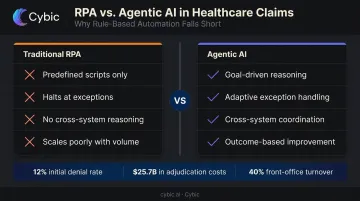
RPA was built for one thing: executing defined rules on structured, predictable data. Healthcare claims are neither structured nor predictable.
The Brittle Automation Problem
A typical claims workflow involves scanned documents, physician notes, payer-specific policy variations, coding ambiguities, and cross-system lookups - often all at once. When RPA encounters anything outside its predefined ruleset, it stops. Someone has to step in, triage the exception, and manually push the claim forward.
That creates a backlog pattern that scales directly with volume. Higher claim counts generate more exceptions, and more exceptions consume more staff hours - on triage, not resolution.
The numbers tell the story:
- Nearly 12% of claims are initially denied - each requiring human review, documentation, and rework
- Hospitals spent $25.7 billion in 2023 on claims adjudication battles, up 23% year over year
- The AHA estimated hospitals spent $19.7 billion in 2022 alone trying to overturn denied claims
When Scale Becomes the Breaking Point
Manual exception handling has always been costly. At current denial volumes, it's become unsustainable. With front office turnover at 40% and administrative costs exceeding 40% of total hospital expenses, the math no longer works.
RPA delivered efficiency gains in narrow, repeatable processes. But it can't interpret a missing attachment, cross-reference an updated payer policy, or prioritize which of 50 pending denials to act on first. These are judgment calls - and that's precisely where agentic AI operates.
What Makes Agentic AI Different
The term gets used loosely, so precision matters here.
Gartner defines agentic AI as embedding "autonomous, goal-driven behavior" into systems that can act, make decisions, and execute tasks independently. McKinsey describes AI agents as software components with agency to act on behalf of a user or system - not just respond to prompts, but pursue outcomes.
Three Distinct Roles in a Modern Digital Workforce
| Role | What It Does | What It Can't Do |
|---|---|---|
| RPA | Executes predefined scripts on structured data | Handle exceptions, interpret unstructured inputs |
| Generative AI | Drafts content, summarizes documents, answers questions | Orchestrate multi-step processes or act on outcomes |
| Agentic AI | Pursues goals, coordinates across systems, adapts in real time | Replace clinical judgment or operate outside governance boundaries |
In claims processing, this distinction is operational. An RPA bot moves an approved claim through a payment workflow. A generative AI tool drafts an appeal letter.
An agentic system handles the entire resolution cycle: it analyzes the denial, identifies the root cause, gathers supporting documentation, drafts the appeal, routes it for review, and tracks the response as a single coordinated workflow.
How the Architecture Works
Production-ready agentic claims systems typically operate across three coordinated layers:
- Orchestration layer - sequences and supervises the overall workflow, managing task prioritization and handoffs
- Agent layer - reasons through available data, makes decisions within defined guardrails, and adapts based on intermediate outcomes
- Bot/execution layer - interfaces directly with EHR systems, payer portals, and legacy platforms to complete discrete tasks
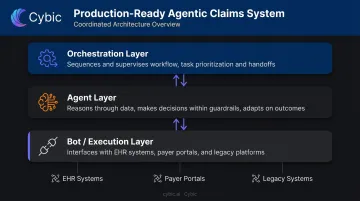
Each layer handles what it's designed for. The orchestration layer doesn't adjudicate; the bot layer doesn't reason. That separation is what allows the system to process complex, exception-heavy claims that RPA alone can't touch.
What Agentic AI Does Not Do
Agentic AI does not replace clinical judgment, does not override compliance requirements, and does not operate without explicit governance boundaries. In healthcare, those constraints are what make deployment viable - they're the conditions under which regulators, compliance teams, and clinical stakeholders can actually approve a production rollout.
How Agentic AI Is Redefining the Healthcare Claims Lifecycle
The claims lifecycle runs from intake through eligibility, coding, adjudication, prior authorization, denial management, and appeals. Traditional automation touches isolated stages. Agentic AI intervenes across all of them.
Intelligent Intake and Claims Triage
At intake, agentic AI processes both structured and unstructured inputs - scanned referrals, physician notes, EHR extracts, patient correspondence - and uses contextual reasoning to assess completeness before the claim moves forward.
Rather than waiting for a denial to surface a missing attachment, the system flags the gap at intake and routes it for resolution. This front-loads quality control where it's cheapest, not at the appeals stage where it's most expensive.
Prior Authorization Automation
The AMA's 2025 physician survey found physicians average 39 prior authorization requests per week, consuming roughly 13 hours of staff time. Medicare Advantage plans alone made 52.8 million PA determinations in 2024.
Agentic AI addresses this by:
- Pulling required clinical documentation directly from EHRs
- Reviewing payer-specific policy rules against the clinical record
- Populating and submitting authorization requests automatically
- Tracking status and escalating only when clinical judgment or borderline cases require human review
Electronic PA standards already show potential savings of $515 million annually and 14 minutes per authorization. Agentic systems extend that baseline with adaptive, end-to-end execution - handling the full workflow, not just form completion at a single point in time.
Claims Adjudication and Coding Accuracy
Agentic systems cross-reference submitted claims against payer contracts, fee schedules, and coding rules in real time. When they identify a missing document or incorrect code, they either auto-correct within defined authority or flag the specific issue for review - rather than routing the entire claim back to a queue.
The result is straight-through processing: claims that require no manual intervention from submission through payment. Fewer touch points mean lower cost and faster cycle times.
Denial Management and Appeals
When a claim is denied, the agentic system:
- Analyzes the denial code to identify root cause
- Cross-references it against historical patterns to distinguish one-off errors from systemic issues
- Prioritizes the appeal by revenue impact and probability of recovery
- Compiles required supporting documentation
- Drafts the initial appeal submission for review
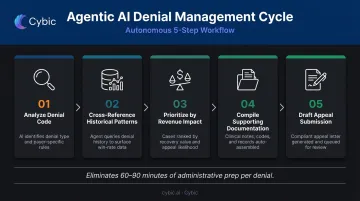
This doesn't replace the claims professional reviewing the appeal - it eliminates the 60–90 minutes of administrative preparation before they can do their actual job. Teams can work significantly more denials per day without adding headcount.
Fraud Detection and Anomaly Identification
Conservative estimates place healthcare fraud at 3% of total expenditures, with some government agencies estimating losses as high as 10%. Agentic AI surfaces anomalies earlier in the cycle than manual review teams typically can. These include duplicate billing across overlapping service dates, unusual provider billing patterns, and claim sequences inconsistent with treatment norms. Catching them upstream narrows the window between fraud occurrence and detection.
Measurable Outcomes: What Agentic AI Delivers
The evidence base for agentic AI in claims is still building - but the automation foundation it runs on is extensively documented.
Operational Efficiency Gains
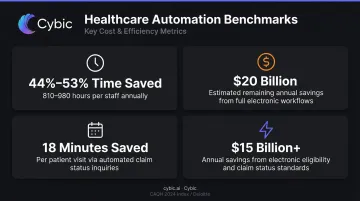
Deloitte estimates automation could save 44%–53% of a claims-processing professional's time - 810 to 980 hours annually per staff member. That's not a marginal efficiency gain; it's a structural reallocation of skilled labor toward work that genuinely requires human judgment.
Additional benchmarks from CAQH's 2024 Index:
- Automating claim status inquiries saves up to 18 minutes per patient visit on average
- Fully electronic workflows hold an estimated $20 billion in remaining annual savings
- Electronic eligibility and claim status standards alone could save over $15 billion annually
In one documented implementation, a national health plan moved claim attachments to EDI and achieved 55% cost savings, reduced manual transactions from 62% to 38%, and improved reassociation rates above 90%.
Staff Experience and Retention
When agents handle document collection, code validation, status tracking, and appeal drafting, claims professionals can redirect their time toward complex cases that require actual expertise. This reallocation reduces the repetitive-task burnout behind persistently high front-office turnover, making it more viable to retain experienced staff rather than constantly backfilling roles.
Financial Impact
Cost reduction flows from multiple directions simultaneously:
- Lower cost per electronic transaction vs. manual ($2.59–$3.42 vs. $5.71–$6.35)
- Reduced rework cost from fewer initial denials
- Faster denial resolution and revenue recovery
- Decreased administrative overhead per claim across the full lifecycle
Governance, Compliance, and Human Oversight by Design
HIPAA compliance in an agentic AI deployment is not a feature you add at the end. It has to be embedded in the architecture from the first design decision.
Non-Negotiable Architectural Requirements
Any agentic AI system operating in a HIPAA-regulated claims environment must include:
- Role-based access controls (RBAC) that limit data access by system component and user role
- Encrypted data handling in transit and at rest, without exception
- Audit trails providing a logged, traceable record of every AI-driven action and decision
- PHI exclusion from model training - client data cannot be used to retrain or fine-tune underlying models
- Business associate compliance - AI vendors processing claims PHI carry full HIPAA breach notification obligations
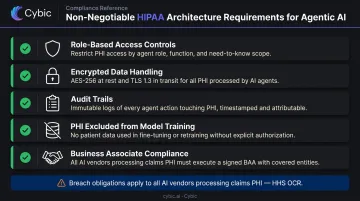
The Change Healthcare incident demonstrated what happens when those controls fail at the clearinghouse level. HHS OCR's dedicated FAQ on that incident makes clear that breach duties apply to business associates - and AI vendors processing claims data are business associates.
Human-in-the-Loop Is Architecture, Not Policy
That compliance exposure is also why human oversight cannot be treated as an optional layer. Autonomous capability and human oversight operate in defined zones - agentic systems need to be programmed to recognize the boundaries of their authority.
Escalation to human review is required for:
- Clinical determinations or borderline medical necessity decisions
- High-revenue, high-risk claims outside established patterns
- Edge cases the system cannot resolve with sufficient confidence
- Any action that would be irreversible without human sign-off
Gartner recommends that regulated-industry agentic deployments include logged decisions, defined fail-safes, and active monitoring of failure rates, drift, and reproducibility. Without those controls, a system may perform well in testing and degrade unpredictably in production - the exact failure mode that claims environments cannot afford.
How Cybic Approaches Governance in Healthcare
Cybic embeds governance at the architectural level across all healthcare engagements. Every deployment includes RBAC, encrypted data protection, end-to-end audit trails, and a strict policy prohibiting proprietary enterprise data from being used to train underlying models.
Solutions are designed to meet SOC 2, HIPAA, ISO, and GDPR requirements. The architecture enforces those controls across cloud, hybrid, or on-premises environments - so organizations don't have to choose between compliance and operational flexibility.
How to Build Your Agentic AI Claims Strategy
Start With a Pilot, Not a Platform Overhaul
The organizations that deploy agentic AI successfully don't start by rebuilding their claims infrastructure. They identify a high-volume, measurable process - a specific denial type, a defined stage of the prior authorization workflow, a particular claim category with a known exception rate - and run a controlled pilot.
The pilot establishes a baseline. Cycle time before and after. Exception rate. Staff hours per resolved denial. That evidence justifies broader deployment and gives the team confidence in the system's behavior before it operates at scale.
Pre-Deployment Requirements
Before any agentic system goes into a claims workflow, three things need to be in place:
- Real-world training data - not sanitized test data, but actual claims that reflect the complexity, ambiguity, and exception patterns the system will encounter in production
- Integration architecture - connections to existing EHR and claims management systems that don't require replacing the platforms already in place
- Defined escalation framework - explicit criteria specifying when and how the AI hands off to human staff, with no ambiguity about authority boundaries
Meeting these requirements depends heavily on the implementation partner. Cybic's infrastructure-agnostic approach supports deployments across AWS, Azure, and Google Cloud - or on-premises - so healthcare organizations can layer intelligence onto existing infrastructure without being locked into a new platform ecosystem.
Avoid These Two Failure Modes
Generic AI without healthcare context. A general-purpose LLM or workflow tool has no knowledge of payer-specific policy rules, coding standards, or the nuances of denial patterns by claim type. Without healthcare-specific workflow logic, the system generates plausible-looking outputs that don't survive contact with actual payer adjudication rules.
Vendors who overstate maturity. Agentic AI in claims is an emerging category. Partners who promise fully autonomous end-to-end claims resolution on day one haven't done this work in production. The right partner brings engineering-led delivery, cross-system integration experience, and the ability to operate across the full compliance stack from day one.
Frequently Asked Questions
What exactly is agentic AI in the context of healthcare claims processing?
Agentic AI pursues defined goals autonomously, decomposing complex claims workflows into tasks, reasoning through exceptions, and coordinating across systems without constant human input. Unlike RPA (which follows scripts) or generative AI (which produces content), agentic AI manages the entire resolution journey within defined governance guardrails.
How is agentic AI different from RPA or traditional AI tools already used in claims?
RPA executes predefined rules on structured data and halts at exceptions. Generative AI drafts and summarizes but cannot orchestrate a multi-step process. Agentic AI combines goal-directed reasoning with cross-system coordination, adaptive exception handling, and outcome-based decision improvement.
Can agentic AI handle prior authorization and denial management end-to-end?
Yes. It can automate both workflows end-to-end, from gathering clinical documentation and submitting PA requests to analyzing denial codes and drafting appeals. The system escalates to human staff for clinically complex cases, borderline medical necessity determinations, or decisions outside its defined authority.
How does agentic AI maintain HIPAA compliance and protect patient data?
A compliant architecture requires RBAC, encrypted data handling in transit and at rest, audit trails for every AI-driven action, and explicit exclusion of PHI from model training. Vendors processing claims data operate as HIPAA business associates, carrying full breach notification obligations under HHS OCR guidance.
What kind of ROI or performance improvement can healthcare organizations realistically expect?
Documented benchmarks point to 44%–53% time savings for claims staff, significant reductions in manual transaction costs, and $20 billion in estimated remaining annual savings from fully electronic workflows. Results depend on deployment scope, data quality, and which stages of the claims lifecycle are targeted first.
Do we need to replace our existing claims platform to implement agentic AI?
No. Agentic AI integrates with existing EHR and claims management infrastructure through APIs and data connectors. The right architecture draws value from legacy systems while layering intelligence on top - no platform replacement or forced migration required.