Introduction
Financial institutions sit on enormous volumes of data - trading records, loan files, customer profiles, claims documents, market feeds - yet most struggle to turn that data into actionable decisions. The problem isn't volume. It's fragmentation.
A 2016 ECB review of 25 significant institutions found that none fully followed risk-data aggregation principles, with some requiring 40+ working days to produce monthly risk reports. That's a structural failure, not a staffing one.
That fragmentation has a cost beyond compliance. McKinsey estimates generative AI could add $200B to $340B in annual value to global banking - roughly 2.8% to 4.7% of annual revenues. Institutions that can't unify their data first won't capture that value.
This guide breaks down how Snowflake's Financial Services Data Cloud addresses that problem - the platform's architecture, AI capabilities, compliance controls, and the practical steps to deploy it.
What You'll Learn (TLDR)
- Snowflake's Financial Services Data Cloud consolidates structured and unstructured financial data into one governed, queryable environment
- Cortex AI bridges raw financial data and business decisions through agentic workflows, natural language querying, and automated ML
- Core use cases include fraud detection, credit risk modeling, portfolio management, and mortgage lending
- Sensitive data never leaves the platform - security and compliance controls are enforced throughout
- Security, compliance, and AI observability are embedded into the architecture from the ground up
What Is Snowflake's Financial Services Data Cloud?
Launched on September 14, 2021, Snowflake's Financial Services Data Cloud combines industry-tailored governance, partner-delivered solutions, and critical financial datasets on a single AI data platform. Rather than a separate product, it's Snowflake's core platform configured specifically for the regulatory and operational demands of banks, insurers, and asset managers.
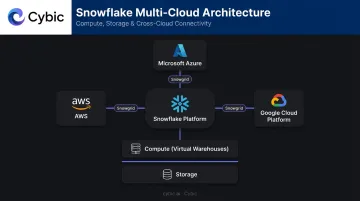
Snowflake separates compute from storage, running queries on independent MPP compute clusters called virtual warehouses while persisting data in central cloud storage. For financial institutions, this means analytics scale on demand - without the performance ceilings of legacy on-premise data warehouses.
The Data Fragmentation Problem Snowflake Solves
Most financial institutions don't have a data shortage. They have a data architecture problem. Transaction systems, CRM tools, market data feeds, claims platforms, and compliance records each live in separate silos, producing departmental snapshots instead of a unified operational picture.
Snowflake consolidates disparate sources into one queryable environment:
- Structured data - financial transactions, trade records, customer account data
- Semi-structured data - JSON from APIs, customer interaction logs
- Unstructured data - loan documents, earnings call transcripts, claims reports, regulatory filings
Multi-Cloud, Infrastructure-Agnostic Architecture
That unified data environment needs equally flexible infrastructure to run on. Snowflake operates on AWS, Microsoft Azure, and Google Cloud Platform, letting financial institutions deploy within their existing cloud agreements, meet regional data residency requirements, and avoid vendor lock-in. Snowflake's cross-cloud technology (Snowgrid) supports data ecosystems that span multiple providers and regions - particularly relevant for global institutions operating under different regulatory regimes.
Core Capabilities of Snowflake Cortex AI for Financial Services
Cortex AI is the suite of AI tools sitting directly on top of the Snowflake data platform. The design principle is straightforward: AI capabilities come to the data, not the other way around. Sensitive financial data never leaves Snowflake's governed environment to be processed by external models. Three capability layers make this work in practice - data readiness, agentic automation, and accessible interfaces for non-technical users.
Making Enterprise Data AI-Ready
Snowflake Openflow (built on Apache NiFi) handles ingestion of structured and unstructured data - customer documents, call center transcripts, claims reports, audio, video, sensor data - across traditionally siloed environments.
Cortex AISQL embeds AI directly into SQL functions. Analysts can use AI_TRANSCRIBE for earnings calls, AI_SUMMARIZE_AGG for analyst reports, and AI_SENTIMENT for market sentiment analysis, all without specialized ML knowledge or leaving their existing SQL workflows.
Third-party data access is available through two channels on the Snowflake Marketplace:
| Channel | Type | Providers |
|---|---|---|
| Sharing of Semantic Views | Structured data | MSCI, Deutsche Börse, Nasdaq eVestment |
| Cortex Knowledge Extensions | Unstructured content | FactSet, The Associated Press, Investopedia |
Agentic AI for Workflow Automation
Cortex Agents orchestrate across structured and unstructured data sources. They plan tasks, break down complex queries, and retrieve relevant context through Cortex Analyst and Cortex Search. The result: research cycles that once consumed hours of analyst time get resolved in minutes.
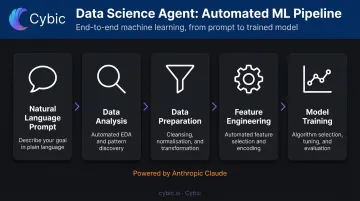
The Data Science Agent (announced June 3, 2025) takes a natural language prompt and autonomously works through an ML pipeline: data analysis → data preparation → feature engineering → model training. Powered by Anthropic Claude, it produces fully functional ML pipelines in Snowflake Notebooks.
Credit risk and fraud detection models that previously took months to build can now be produced in a fraction of that time.
Snowflake Intelligence for Business Users
Snowflake Intelligence is the conversational interface designed for business users who don't write SQL. Portfolio managers, underwriters, and mortgage bankers can query structured tables, unstructured documents, and third-party data in plain English. Key user groups include:
- Portfolio managers analyzing cross-asset positions and market data
- Underwriters pulling policy and risk documentation
- Mortgage bankers querying loan data and compliance records
Snowflake's managed MCP (Model Context Protocol) Server, which entered public preview on October 1, 2025, connects these capabilities to external agent platforms including Anthropic's Claude and CrewAI through a standardized, secure pipeline.
Key Use Cases: What Financial Institutions Are Building on Snowflake
Risk Modeling and Fraud Detection
The Data Science Agent automates the full ML pipeline for credit risk modeling - from raw data to a trained, validated model - compressing development cycles that previously ran for months. Governance controls maintain auditability on model decisions throughout.
For fraud detection, Snowflake's financial crimes platform supports real-time transaction monitoring by consolidating data across business units. Cortex Agents continuously scan transaction patterns across structured and unstructured sources.
AI Observability tools track model drift over time, flagging when accuracy degrades so teams can intervene before false negatives accumulate.
A Snowflake developer guide for credit card fraud detection demonstrates anomaly detection and classification models for transaction scoring using Snowflake ML Functions directly.
Market Analysis and Portfolio Management
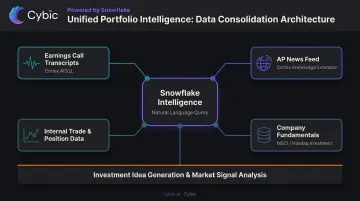
Portfolio managers can combine multiple data streams through a single natural language interface:
- Earnings call transcripts processed via Cortex AISQL
- News from the AP Cortex Knowledge Extension
- Company fundamentals from MSCI or Nasdaq eVestment via Semantic Views
- Internal trade and position data
The result is investment idea generation and market signal analysis without the usual coordination overhead between data, quant, and research teams. Nasdaq eVestment's agentic AI integration on the Snowflake Marketplace demonstrates this consolidation in practice for asset management prospecting.
Insurance Underwriting and Mortgage Lending
- Underwriters can pull AI-generated risk summaries from property data providers like Cotality's Mortgage Transaction Data (covering borrower, lender, and mortgage details with up to 50 years of history), claims documents, financial history, and customer communications - enabling faster, more consistent risk evaluations.
- Mortgage bankers can use Snowflake Intelligence to query loan documents, property data, and customer financial history simultaneously. Cortex AI Functions for Documents parses, classifies, and extracts information from unstructured loan files - cutting manual document review time for lending teams.
Security, Governance, and Compliance
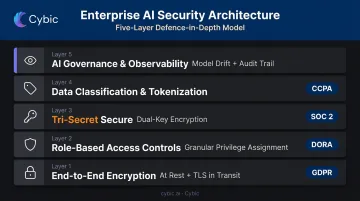
Snowflake's security architecture for financial services includes several layers that regulated institutions specifically need:
- Role-based access controls (RBAC) - privileges assigned to roles, roles assigned to users, with granular control over what each team can access
- Tri-Secret Secure - dual-key encryption combining Snowflake's built-in authentication with a customer-managed key (requires Business Critical edition)
- End-to-end encryption - all data encrypted at rest; TLS encryption in transit
- Data classification - native categories for sensitive data types (name, national identifier) plus custom categories for institution-specific data
- External tokenization - data can be tokenized before loading and detokenized at query runtime
The AI layer carries its own governance controls. According to Snowflake's AI Trust and Safety documentation, customer data and AI inputs/outputs remain within Snowflake's Security Boundary when using Snowflake AI Features. Models run against the data in place; financial records never leave Snowflake's Security Boundary.
That boundary extends to observability as well. Snowflake tracks AI behavior across three dimensions:
- Model drift monitoring through ML Observability
- Accuracy, latency, and usage tracking through Cortex AI Observability
- Full tracing of inputs, outputs, and intermediate steps for auditability
This audit trail is what compliance teams and regulators need for AI-driven decisions in credit scoring, fraud flagging, and underwriting. Snowflake also maps its approach specifically to GDPR data governance requirements and the EU's Digital Operational Resilience Act (DORA) pillars, including ICT risk management and resilience testing.
Getting Started with Snowflake's Financial Services Data Cloud
A Practical Starting Framework
Before any deployment begins, three steps clarify the path:
- Audit your data silos - identify where transaction data, customer records, risk systems, and compliance data currently live, and which use case (fraud detection, market intelligence, credit risk) would deliver the clearest ROI as a pilot
- Assess your cloud infrastructure - determine whether the deployment goes on AWS, Azure, or GCP based on existing agreements, geographic requirements, or security constraints
- Define governance requirements upfront - access control policies, data classification rules, and compliance framework alignment (GDPR, DORA, CCPA, SOC 2) need to be scoped before architecture decisions are made, not after
Why Implementation Expertise Matters
Out-of-the-box Snowflake configuration handles the platform layer. It doesn't handle the engineering work that actually makes a regulated financial institution operational. Getting those decisions wrong at the start means expensive rearchitecting later - a common failure pattern in financial services deployments.
The work that matters includes:
- Custom data pipeline design for financial data sources
- RBAC structures aligned to organizational hierarchies
- AI model integration with proper governance controls
- Compliance-aligned security architecture (GDPR, DORA, CCPA, SOC 2)
- Ongoing observability and post-deployment maintenance

Cybic specializes in engineering-led Snowflake deployments for enterprises where governance, security, and compliance need to be embedded from day one. That means building compliance alignment into the architecture across AWS, Azure, and GCP - not layering it on after the fact.
When evaluating implementation partners, look for two things: genuine experience with regulated industries, and a delivery model oriented around working systems rather than proof-of-concept demos that stall before reaching production.
Frequently Asked Questions
Is Snowflake a legitimate company?
Snowflake Inc. is a publicly traded company (NYSE: SNOW), incorporated in Delaware on July 23, 2012, and headquartered in Menlo Park, California. The company reported $4.68 billion in total revenue for fiscal year 2026 (ended January 31, 2026) and had 9,060 employees across 36 countries as of that date.
Is Snowflake owned by Amazon?
Snowflake is an independent public company, not owned by Amazon or any other cloud provider. It runs on AWS, Microsoft Azure, and Google Cloud Platform, but operates independently across all three - a point that matters for institutions evaluating vendor dependency risk.
Who are Snowflake's biggest clients?
Snowflake serves major financial institutions globally, including Allianz, AXA, BlackRock, Capital One, Goldman Sachs, and the NYSE. Marketplace data providers such as MSCI, FactSet, Nasdaq eVestment, and Deutsche Börse extend its reach into specialized financial workflows.
What financial services use cases does Snowflake best support?
Snowflake's strongest financial services use cases include:
- Fraud detection and financial crimes monitoring
- Credit risk modeling and regulatory compliance reporting
- Market analysis, portfolio management, and insurance underwriting
All run on unified access to structured and unstructured data within a governed environment.
How does Snowflake keep sensitive financial data secure?
Snowflake uses role-based access controls, Tri-Secret Secure dual-key encryption, TLS encryption in transit, and built-in data classification. AI models operate within Snowflake's Security Boundary, meaning financial data is never sent to external systems for processing. This eliminates data egress risks for compliance purposes.
How is Snowflake different from a traditional data warehouse for financial services?
Traditional warehouses tie compute to storage, can't handle unstructured data natively, and require separate AI infrastructure. Snowflake decouples compute from storage for on-demand scalability and supports structured, semi-structured, and unstructured data in one place. AI and ML capabilities are embedded directly in the platform, eliminating the need for a separate analytical stack.