Most agencies have launched pilots. Far fewer have production systems. According to a 2024 NASCIO/McKinsey survey of 49 state CIOs, 34% of states had built GenAI proofs of concept or pilots, but only 10% had moved those initiatives into production. At the federal level, GAO found that reported AI use cases across 11 agencies nearly doubled from 571 to 1,110 between 2023 and 2024-yet production deployments remain a fraction of that inventory.
The technology isn't the problem. Strategy, governance, and implementation discipline are.
This guide is written for agency leaders evaluating AI strategy consulting-what to look for, what use cases to prioritize, and how to separate partners who deliver working systems from those who deliver slide decks.
Key Takeaways
- Most government AI pilots stall before production due to data gaps, governance failures, and weak change management-not technology limitations.
- Document automation, citizen services, fraud detection, and decision support deliver the clearest near-term value for government agencies.
- Effective AI strategy consulting delivers embedded governance, compliance alignment, and engineering-led deployment-not slide decks.
- Regulatory requirements (NIST AI RMF, OMB M-25-21, FedRAMP, FISMA) must be built into AI architecture from day one.
- Choose a consulting partner based on execution track record and governance depth-firm size is secondary.
The Biggest Challenges Blocking AI Adoption in Government Agencies
Understanding why pilots stall matters more than celebrating the ones that launch.
Legacy Infrastructure
The federal government spends over $100 billion annually on IT, with most of that going toward maintaining existing systems. GAO found that of 10 critical legacy systems identified in 2019, only 3 had completed modernization by February 2025.
Most agencies run on fragmented, siloed data stored as scanned images or non-searchable formats. Building effective AI models on top of that requires substantial upstream data work-work that most AI pilots never budget for.
The Skills Gap
53% of state CIOs identified lack of necessary skills as their top concern about AI's impact on the technology workforce, and 50% expressed limited confidence in workforce readiness for GenAI. Without internal technical capacity, agencies can't credibly evaluate vendor proposals, define requirements, or monitor models after deployment.
This creates over-reliance on vendor promises with no internal oversight-a procurement risk GAO has explicitly flagged.
Governance and Public Trust
Government AI decisions affect citizens' access to benefits, housing, immigration status, and public safety. The stakes are higher than in private-sector deployments.
Michigan's MiDAS system is the cautionary example: an auto-adjudication system that falsely accused thousands of residents of unemployment fraud, resulting in a $20 million civil rights settlement in 2022.
MiDAS was not a generative AI system. But the failure pattern - automated decisions without adequate human oversight or explainability - applies directly to modern AI deployments.
A 2025 Pew survey found 50% of Americans are more concerned than excited about increased AI use in daily life. Public trust is an operational constraint, not a soft consideration.
Budget and Procurement Reality
Government budgets are program-specific, not technology-driven. AI investment competes with operational line items and must demonstrate clear mission alignment to survive procurement cycles.
These structural constraints compound a skills problem that extends into procurement itself:
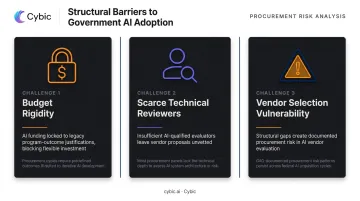
- Budget rigidity forces agencies to justify AI spend against program outcomes, not technology roadmaps
- Scarce technical reviewers mean vendor proposals often go unevaluated by qualified internal staff
- Vendor selection vulnerability results when agencies lack data scientists who can define requirements or assess technical claims - a risk GAO has explicitly documented
High-Value AI Use Cases Government Agencies Should Prioritize
Not all use cases are equal. These five consistently deliver measurable results in government contexts.
Automated Document Processing
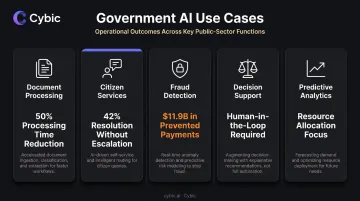
A significant share of government work runs on unstructured documents-permits, filings, applications, correspondence. Pennsylvania's Office of Administration deployed an Intelligent Document Processing solution for Department of Human Services benefits applications (SNAP, Medicaid) and reported processing time reductions of up to 50% with improved accuracy.
Firms like Cybic build IDP solutions that combine OCR, NLP, and classification models to handle document routing and extraction at scale-integrating directly into existing agency workflows rather than requiring system replacement.
Citizen-Facing AI and Service Delivery
Rule-based chatbots from the early 2010s set low expectations. LLM-based assistants grounded in agency knowledge bases perform differently. The IRS deployed a chatbot in December 2021 that handled over 450,000 interactions by September 2022, resolving 42% without escalation to a live agent.
A separate authenticated voice bot launched in June 2022 handled more than 1 million calls in its first two months, helping establish roughly 7,600 installment agreements covering $50 million in balances due.
The critical design element: strict access controls, knowledge grounding limited to agency-approved content, and clear escalation paths to human agents.
Fraud Detection and Tax Compliance
CMS estimated it prevented $11.9 billion in potentially fraudulent Medicare payments from FY2022 through FY2024 through administrative actions, with approximately $2.057 billion linked directly to its Fraud Prevention System.
These are projected cost-avoidance estimates, not collected funds. Even so, the scale of pattern detection achievable through predictive analytics and anomaly detection is not replicable through manual review.
Decision Support for Complex Determinations
This distinction matters for regulatory classification and public trust: AI does not decide. In high-stakes determinations-zoning, benefits eligibility, environmental review-AI organizes relevant precedents, flags inconsistencies, and reduces casework preparation time. Proper implementation requires:
- A human makes every final determination
- Citizens retain the right to request human review
- Any consulting partner who blurs this line should be disqualified immediately
Predictive Analytics for Resource Allocation
Operational data-health system flows, infrastructure maintenance patterns, public safety call volumes-can feed forecasting models that help agencies deploy limited resources more precisely. Published, post-2021 measurable outcomes in this space remain limited. Agencies should scope these engagements carefully against available data quality before committing to production targets.
What Effective AI Technology Strategy Consulting Looks Like for Government
Most large consulting firms produce roadmaps. What agencies actually need is an implementation partner who builds and integrates directly.
Start With a Readiness Assessment
Effective consulting begins with an honest assessment across four dimensions before any use case selection or vendor evaluation:
- Data quality - Is data structured, accessible, and clean enough to train or fine-tune models?
- Process maturity - Are the underlying workflows documented and stable, or still ad hoc?
- Workforce capability - Can staff engage with AI outputs, flag errors, and manage escalation?
- Governance structure - Are accountability roles, oversight mechanisms, and compliance processes defined?
Any consulting partner that skips this step and jumps to tool selection is selling a solution before diagnosing the problem.
Governance Embedded by Design
Compliance cannot be retrofitted after deployment. Security controls, role-based access, auditability of AI-driven actions, and alignment with FedRAMP/FISMA requirements should be designed into the system architecture from the start.
Cybic builds these controls into the architecture before deployment begins:
- RBAC - Role-based access controls scoped to agency personnel and system roles
- Encrypted data protection - In transit and at rest, aligned with federal standards
- Audit trails - Full traceability of AI-driven actions and decisions
- Data governance policy - No model training on proprietary client data, by design
This eliminates the retrofit problem entirely - agencies go live with compliance already in place, not scrambling to add it afterward.
Engineering-Led Delivery
There's a meaningful difference between a strategy consulting engagement and an implementation engagement. Most large firms deliver the former and hand off to a separate team - or to the agency - for execution. The gap between design and deployment is where most government AI projects fail.
The questions to ask any consulting partner:
- Who actually builds the system - your engineers or subcontractors?
- Can you demonstrate the solution on our data, not a reference dataset?
- What does model monitoring and retraining look like post-deployment?
- What are the exit conditions and data portability terms?
- How does your governance framework align with NIST AI RMF?
That last question matters more than most agencies realize - a partner who can't answer it clearly hasn't built governance into their delivery model.
Infrastructure Flexibility
Agencies operate across cloud, hybrid, and on-premises environments - often with significant legacy constraints. An effective partner designs infrastructure-agnostic solutions that adapt to what's already in place, not what would be convenient to replace.
Cybic's architecture runs across AWS, Azure, and Google Cloud, as well as hybrid and on-premises configurations, without requiring wholesale infrastructure replacement or forcing vendor consolidation before the agency is ready.
A Realistic 90-Day Engagement Structure
Production-ready AI in government requires preparation that most agencies skip:
- Days 1–30: Political mandate alignment, use case scoping, stakeholder mapping
- Days 31–60: Data audit, governance readiness gap analysis, minimum viable use case definition
- Days 61–90: Build vs. buy decision, vendor or partner selection, prototype kickoff
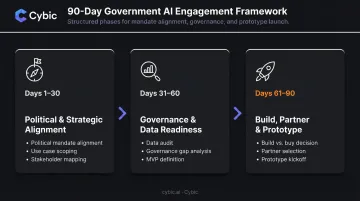
The goal is not another pilot. It's building the conditions for a production-ready system within six months.
Navigating AI Governance, Compliance, and Security in the Public Sector
The Core Regulatory Framework
U.S. government agencies must align with:
- OMB M-25-21 (April 2025): "Accelerating Federal Use of AI through Innovation, Governance, and Public Trust" - the current guidance on responsible federal AI adoption
- OMB M-25-22 (April 2025): "Driving Efficient Acquisition of Artificial Intelligence in Government" - requirements for AI procurement
- NIST AI Risk Management Framework - the primary U.S. reference for managing AI risks across governance, data, performance, and monitoring
- FedRAMP - cloud service authorization requirements; agencies must confirm applicability for specific use cases
- FISMA - federal information security requirements
- Sector-specific rules - HIPAA in healthcare, additional requirements in defense and social services
State agencies should also check relevant state-level frameworks. California's EO N-12-23, Colorado's SB24-205, and Texas DIR's AI and Innovation guidelines each create jurisdiction-specific obligations.
Human-in-the-Loop Is Non-Negotiable
Any AI system that influences determinations affecting individual rights (benefits eligibility, immigration, taxation, law enforcement) must maintain human oversight and explainability. Citizens must be able to request human review. Every high-profile government AI failure traces back to systems that bypassed this principle.
Data Governance Obligations
Maintaining that human oversight layer depends on sound data governance underneath it. Before procurement, agencies should verify:
- Privacy impact assessments completed
- Data minimization requirements defined
- No AI model training on citizen data without explicit authorization
- Encrypted data handling in transit and at rest
- Audit trails for all AI-driven actions documented
Surfacing these requirements at the procurement stage - not during deployment - is what separates compliant implementations from costly remediation projects.
How to Choose the Right AI Consulting Partner for Your Agency
Firm size is not a reliable indicator of AI consulting quality. Large system integrators managing hundreds of simultaneous programs often provide junior staff, produce generic frameworks, and leave execution to the agency.
Boutique and specialized AI engineering firms tend to offer faster implementation cycles, direct senior engineer access, and clearer accountability. Cybic, for instance, builds governed AI systems that are infrastructure-agnostic and engineering-led - designed to integrate with your environment from day one, not after the fact.
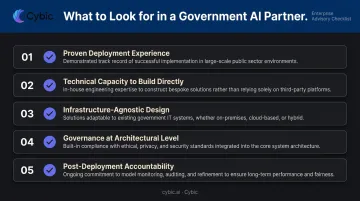
Five criteria that actually matter:
- Proven deployment experience : Ask for examples of production systems, not strategy documents
- Technical capacity to build and integrate directly - not just advise
- Infrastructure-agnostic design: No vendor lock-in; the solution adapts to your environment
- Governance embedded at the architectural level: RBAC, audit trails, and compliance alignment from day one
- Clear post-deployment accountability : Model monitoring, retraining commitments, and SLA terms in writing
Once you've assessed these criteria, the next step is to pressure-test the answers. These questions cut through polished proposals:
- Can you demonstrate this on our data, not a reference dataset?
- Who maintains the model after go-live, and on what schedule?
- What happens to our data if we end the engagement?
- How does your governance framework align with NIST AI RMF?
Frequently Asked Questions
What does an AI technology strategy consultant do for government agencies?
An AI strategy consultant helps agencies identify high-value use cases, assess readiness across data, processes, and governance, design compliant AI architectures, and manage implementation. Strong partners stay engaged through deployment and post-launch performance, not just the roadmap phase.
How long does it take to implement an AI solution in a government agency?
A well-scoped engagement typically requires 30–90 days of preparation - covering data audits, governance setup, and use case definition - followed by a 3–6 month pilot before stable production deployment. Agencies with data quality or governance gaps should plan for additional front-end time.
What regulations govern AI use in U.S. federal and state government agencies?
Federal agencies must align with OMB M-25-21 and M-25-22, the NIST AI Risk Management Framework, FedRAMP, and FISMA, plus sector-specific requirements in healthcare and defense. State agencies should also review applicable state-level AI governance laws, which vary significantly by jurisdiction.
How do government agencies ensure AI systems are secure and compliant?
Security and compliance must be embedded at the architectural level - through RBAC, encrypted data handling, auditability of AI-driven actions, and FedRAMP/FISMA alignment - rather than applied after deployment. Retrofitting compliance onto a deployed system is significantly more expensive and less reliable.
What is the difference between AI strategy consulting and AI implementation for government?
Strategy consulting defines the roadmap and use cases. Implementation involves actually building, integrating, and deploying the AI system into the agency's existing infrastructure. The most effective partners handle both. Handing off after strategy is one of the most common failure points in government AI programs.
How do government agencies measure ROI from AI investments?
Establish baseline metrics before deployment - staff hours per process, case processing times, error rates, and citizen response times. ROI is measured against those baselines post-deployment, factoring in both direct cost savings and service quality improvements.