Introduction
Patent attorneys are under real pressure. Global patent filings reached 3.7 million in 2024, up 4.9% year-over-year, while the USPTO's unexamined application inventory hit 837,928 in January 2025 with first-action pendency stretching to 20.5 months. Firms handling dozens of active matters simultaneously are finding that manual-only workflows simply don't scale.
AI has emerged as a practical response to that pressure - accelerating prior art searches, speeding up specification drafting, and giving prosecution teams a head start on office action responses - while attorney judgment remains the controlling layer throughout.
The hesitation in the legal industry is legitimate. Confidentiality obligations, hallucination risks, and regulatory uncertainty have kept many firms on the sidelines.
This guide addresses all three directly:
- Where AI genuinely helps in the patent workflow
- How compliant, auditable workflows are structured
- Where the legal guardrails sit
- What governance architecture looks like when client confidentiality isn't negotiable
Key Takeaways
- AI is deployed across four core patent workflows: prior art search, specification drafting, claim generation, and office action responses
- Only natural persons can be named as inventors; AI is a drafting tool, not an inventive entity (Thaler v. Vidal, 2022)
- Confidentiality is the critical risk: any AI platform that retains or trains on submitted data can destroy patent novelty before filing
- For pre-filing, unpublished inventions, only platforms with governance embedded at the architecture level are viable
Where AI Is Transforming Patent Work
The volume problem is real and growing. With 4.7 million patent applications pending worldwide (excluding China) and USPTO first-action pendency now exceeding 20 months, manual-only workflows create bottlenecks at every stage.
AI addresses four of the most time-intensive areas:
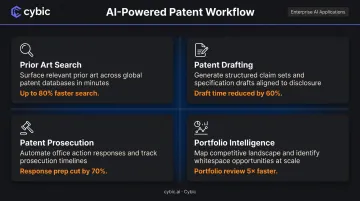
Prior Art Search
Manual keyword searches across international patent databases take hours and miss semantically related prior art that different terminology can obscure. AI tools using natural language processing scan millions of records in seconds, surfacing ranked results that human reviewers can then evaluate.
The USPTO has validated this approach internally. Its PE2E AI Similarity Search gives patent examiners AI-assisted functionality that returns results in seconds. The agency's Artificial Intelligence Search Automated Pilot Program (ASAP) now sends applicants ranked prior art documents before full examination begins - confirming that AI-assisted search is operationally accepted within the examination process itself, even if it's not a blanket endorsement for practitioner submissions.
EPO's Espacenet now covers 160 million patent documents. No AI search tool replaces attorney analysis of those results - but it changes what's feasible to review.
Patent Drafting
AI accelerates specification writing by ingesting inventor disclosure documents and generating background sections, detailed descriptions, and figure descriptions. It handles the structural scaffolding that consumes hours of attorney time without adding legal value.
Claim drafting is different. Claims are the legal boundary of the patent. That work requires direct attorney control and judgment - AI can generate a draft claim set for attorney review, but no compliant workflow allows claims to proceed without the practitioner's deliberate engagement at that stage.
Patent Prosecution
Office action responses follow a predictable analytical structure. Each response requires the attorney to:
- Parse the examiner's rejection reasoning
- Review cited prior art and assess claim scope
- Draft arguments addressing each ground of rejection
AI handles the initial framework for this process, cross-referencing cited references, flagging relevant distinctions, and generating a response skeleton.
The attorney still verifies every legal argument and factual assertion before signing. Under 37 C.F.R. § 11.303, a practitioner cannot knowingly make a false statement to the USPTO - and a signed submission certifies that the required review occurred.
Portfolio Intelligence
In-house legal teams are using enterprise AI to audit existing portfolios at a scale that wasn't previously practical. Typical applications include:
- Identifying dormant patents that no longer serve a business function
- Flagging potential infringement exposure across competitor filings
- Surfacing continuation filing opportunities before deadlines pass
This shifts patent strategy from reactive to proactive without requiring a proportional increase in headcount.
How AI-Assisted Patent Generation Actually Works
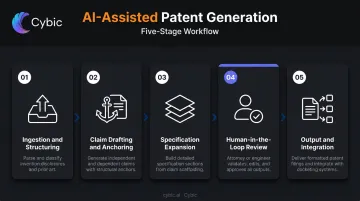
AI patent tools don't operate from a single prompt. They follow a structured, multi-stage workflow that keeps the attorney at the center of every consequential decision.
Stage 1: Ingestion and Structuring
The attorney or inventor uploads disclosure documents, technical whitepapers, or rough drawings. The AI parses this unstructured input and organizes it into defined technical entities (components, functions, relationships) that serve as the foundation for drafting. Nothing is fabricated at this stage - the system organizes only what it receives.
Stage 2: Claim Drafting and Anchoring
The claim set is the legal anchor of the patent. Two approaches are common:
- The attorney drafts claims first, and the AI expands specification content from those anchors
- The AI generates a draft claim set that the attorney reviews and refines before anything proceeds
Either way, attorney control at this stage is non-negotiable. Claims define the scope of protection, and the Pannu significant-contribution test (discussed below) requires that the inventive conception originate from a human mind.
Stage 3: Specification Expansion
Once claims are validated, the AI uses them to generate the detailed description, alternative embodiments, and summary sections. The key constraint: expansion is grounded in the disclosure and the validated claims, not fabricated outside the source disclosure. Well-designed systems flag when they're filling gaps rather than describing disclosed content.
Stage 4: Review, Error Checking, and Human-in-the-Loop
Enterprise AI platforms include automated checks for:
- Antecedent basis errors
- Term consistency across claims and specification
- Claim support for all limitations
These checks catch mechanical issues efficiently. Automated checks can't catch everything, though. The human-in-the-loop (HITL) review step is where attorneys catch hallucinations, verify technical accuracy, and confirm § 112 compliance. No automated check replaces that judgment.
Stage 5: Output and Integration
The system exports final drafts into standard formats (Word, USPTO-compatible XML) and pushes them directly into existing IP management and docketing systems. The workflow augments what firms already do - it doesn't require rebuilding operations around a new platform.
The Legal Guardrails: Inventorship, USPTO Guidance, and Duty of Candor
Inventorship: The Human Requirement
In Thaler v. Vidal, 43 F.4th 1207 (Fed. Cir. 2022), the Federal Circuit held that the Patent Act requires inventors to be natural persons. An AI system cannot be named as an inventor - full stop.
The USPTO's 2024 Federal Register guidance (89 Fed. Reg. 10043) confirmed this position and applied the Pannu significant-contribution test: a human inventor must contribute in some significant manner to conception, with a contribution that carries meaningful weight against the full invention.
For AI-assisted drafting, that means firms should maintain a clear record of human involvement at every stage. Specifically, capture:
- Prompt history and human edits to AI-generated output
- Inventor review records and sign-offs
- Contribution notes at the claim and feature level
If inventorship is ever challenged, the attorney needs to demonstrate precisely where human conception occurred.
The Duty of Candor
Using AI to generate specification language is lawful. Submitting AI output without rigorous verification is not.
Three rules govern this:
- 37 C.F.R. § 1.56 - each person involved in filing and prosecution has a duty to disclose known material information
- 37 C.F.R. § 11.18 - a signed submission certifies the practitioner made inquiry reasonable under the circumstances and has evidentiary support for factual assertions
- 37 C.F.R. § 11.303 - practitioners cannot knowingly make false statements to the USPTO
The USPTO has explicitly stated that AI tools do not displace these duties. Relying on unverified AI output carries real consequences:
- Hallucinated prior art citations submitted as fact
- Fabricated technical claims that misrepresent the invention
- Unsupported limitations that undermine claim scope
- Disciplinary action against the practitioner and potential patent invalidation
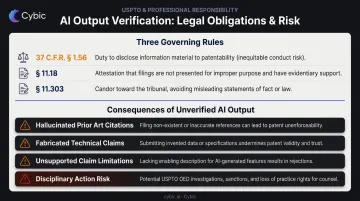
Every piece of AI-generated content in a patent filing requires attorney verification before submission.
Confidentiality and Data Governance: The Defining Challenge
Why the Stakes Are Exceptionally High
In most industries, a data breach is a compliance problem. In patent practice, it can be something worse: disclosure of an invention before the filing date destroys novelty. An AI platform that retains, logs, or trains on submitted inventor disclosures could constitute a prior disclosure - potentially invalidating the application before it's ever examined.
This concern is recognized across jurisdictions. The epi's 2024 generative AI guidelines require members to ensure adequate confidentiality when using AI tools. IPReg's Core Regulatory Framework (in force since 2023) includes confidentiality obligations for UK patent and trademark attorneys. ABA Formal Opinion 512 (2024) requires lawyers to evaluate confidentiality implications before using generative AI with client data.
The LLM Data Chain Problem
Most AI patent tools are built on foundational models from OpenAI, Anthropic, or Google. When an attorney submits a confidential inventor disclosure, that input may be transmitted to and processed by the underlying provider's infrastructure.
Each provider handles this differently:
| Provider | Training Policy | Retention Controls |
|---|---|---|
| OpenAI API | API inputs not used for training by default | Zero data retention available for qualifying orgs |
| Anthropic API | API retention and zero-retention options documented | Must use API terms, not consumer Claude terms |
| Google Cloud / Vertex AI | Customer data not used for AI training without permission | Governed by Cloud enterprise terms |
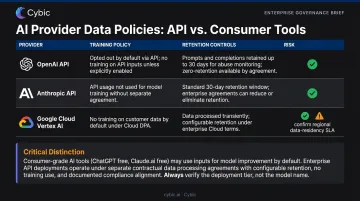
The critical distinction: consumer-grade tools and enterprise API deployments operate under materially different terms. An attorney using a consumer ChatGPT interface has no data retention protections. An attorney using an enterprise API deployment with contractual no-training and configurable retention commitments has a very different risk profile.
There's a second, less-discussed risk: even if a vendor claims not to train on your data, they may retain inputs for prompt optimization or platform improvement. Attorneys need explicit contractual commitments covering both dimensions.
What Governance-First Architecture Looks Like
Enterprise AI platforms built for regulated industries embed security controls at the architecture level, not as post-deployment add-ons. The requirements for patent work specifically:
- Encrypted data handling in transit and at rest
- Role-based access controls (RBAC) limiting who can view which client matters
- No training on proprietary client data - documented and enforced, not just claimed
- Full auditability of AI-driven actions so attorneys can demonstrate human review occurred
- Matter-level data segregation preventing cross-contamination between client files
- Infrastructure options (private cloud, on-premises) for firms that cannot accept multi-tenant environments
Cybic builds enterprise AI systems with these controls embedded from the ground up - not added after deployment. The platform incorporates governance, RBAC, auditability, and compliance alignment (SOC 2, HIPAA, ISO, GDPR) directly into its architecture. For law firms handling unpublished, pre-filing IP, that posture is the baseline - not a premium tier.
What to Look for in an Enterprise AI Patent Solution
Core Evaluation Criteria
Before any AI patent tool processes a client disclosure, firms should evaluate vendors on three dimensions:
- Data sovereignty: Where is data processed and stored? Can the firm deploy on dedicated or on-premises infrastructure rather than shared multi-tenant environments?
- LLM provider transparency: What are the actual retention and training terms with the underlying model provider? Ask for the provider agreement, not just the vendor's summary.
- Integration capability: Does the platform connect to existing IP management, docketing, and document workflows - or does it require rebuilding operations around a new system?
The Custom vs. SaaS Decision
Off-the-shelf SaaS tools offer accessibility and fast deployment. However, multi-tenant environments carry inherent data exposure risks for firms handling sensitive, pre-filing inventions. One firm's disclosure should never be accessible to another firm's query - even inadvertently.
Custom enterprise AI platforms - deployed on private or dedicated infrastructure and fine-tuned on a firm's own historical patent corpus - deliver two specific advantages:
- Data sovereignty: Client disclosures stay isolated, with no cross-contamination risk from shared environments
- Domain-matched outputs: The system learns the firm's technical specializations and drafting conventions
Cybic builds governance-embedded, infrastructure-agnostic AI systems that address both, including fully on-premises deployment for firms where data control is non-negotiable.
Pre-Deployment Checklist
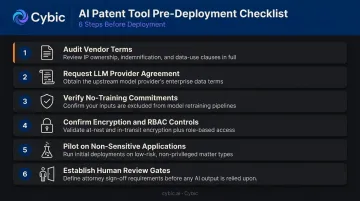
Before any AI patent tool goes live on active client matters:
- Audit the vendor's terms of service - specifically the data retention and usage clauses
- Request the LLM provider agreement - don't accept a vendor's summary; read the underlying terms
- Verify no-training commitments - confirm coverage extends to prompt optimization, not just model training
- Confirm encryption and RBAC controls - at the architecture level, not as optional add-ons
- Pilot on non-sensitive applications - test the tool on expired or published patents before deploying it on unpublished client inventions
- Establish human review gates - document the HITL checkpoints so attorney oversight is traceable
Frequently Asked Questions
Can AI be listed as an inventor on a patent application?
No. Under Thaler v. Vidal (Fed. Cir. 2022) and the USPTO's 2024 inventorship guidance, only natural human persons can be named as inventors. AI systems are treated as drafting tools - the inventive conception must originate from a human mind and be documentable as such.
What are the biggest risks of using AI for patent drafting?
The primary risks are hallucinated prior art or technical detail that survives into a filed application, confidentiality breaches from platforms that retain submitted data, and duty of candor violations under 37 C.F.R. § 1.56 and § 11.18 when AI output is filed without rigorous attorney review.
How does AI handle confidentiality when processing unpublished inventions?
It depends entirely on the platform. Enterprise AI solutions with proper governance encrypt data, prevent training on client inputs, and operate in isolated processing environments. Consumer-grade tools often retain submitted data and may use it in ways that could constitute prior disclosure - a potentially fatal risk for patent validity.
What is the difference between a generic AI tool and a purpose-built enterprise solution?
Purpose-built platforms are fine-tuned on patent corpora, hosted on private infrastructure, and designed with legal accuracy and workflow integration as core requirements. General-purpose LLMs lack patent-specific precision, confidentiality controls, and the prosecution workflow integrations practitioners actually need.
Does using AI in patent drafting violate professional responsibility rules?
Using AI is not inherently a violation. Practitioners remain fully responsible for verifying AI output under their applicable code of conduct - and must ensure any tool they use meets confidentiality obligations, including 37 C.F.R. § 11.106 and applicable bar authority guidance such as ABA Formal Opinion 512.
How should a law firm evaluate an AI vendor before using it for patent work?
Verify the provider agreement confirms no data retention or model training on client inputs - including prompt optimization. Confirm encryption and RBAC controls are architectural requirements, not optional add-ons. Pilot on published, non-sensitive matters before deploying on any active pre-filing invention.