What is legacy application migration and why does my enterprise need it?
Legacy application migration is the process of moving outdated software systems often built on obsolete code, monolithic architectures, or aging on-prem infrastructure to modern, cloud-native environments. Enterprises need it to eliminate technical debt, improve performance and scalability, reduce security vulnerabilities, and align systems with current compliance and business requirements. Delaying migration typically increases operational risk and long-term cost.
What is cloud modernization and how is it different from a simple cloud migration?
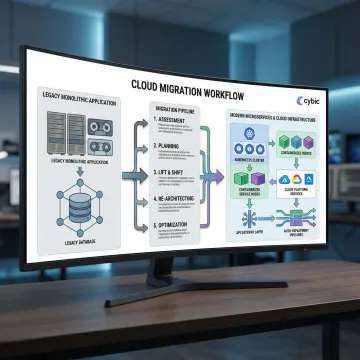
Cloud migration moves existing applications to the cloud largely as-is (lift-and-shift). Cloud modernization goes further re-architecting applications into microservices, optimizing data pipelines, embedding governance controls, and integrating AI-ready infrastructure. Modernization unlocks the full performance, scalability, and cost efficiency of the cloud rather than simply relocating legacy problems to a new environment.
Will migrating our legacy systems disrupt ongoing business operations?
No. Cybic executes migrations in phased, incremental stages specifically designed to prevent operational disruption. Each phase is planned, tested, and validated independently before the next begins. Core business functions remain fully operational throughout the migration. Rollback procedures and parallel-run strategies are built into the migration plan to mitigate risk at every stage.
Which cloud platforms does Cybic support for modernization?
Cybic delivers modernization across all three major cloud platforms like Amazon Web Services (AWS), Microsoft Azure, and Google Cloud. We also support multi-cloud and hybrid architectures for organizations that require data residency flexibility or are transitioning between platforms. Our approach is infrastructure-agnostic, ensuring you are never locked into a single vendor ecosystem.
How does Cybic handle data security and compliance during migration?
Security and compliance are embedded at the architectural level, not applied as a post-migration layer. Cybic implements role-based access controls (RBAC), encrypted data protection in transit and at rest, audit trails, and full traceability of all AI-driven actions. We align with SOC 2, HIPAA, GDPR, and ISO compliance frameworks and conduct no model training on proprietary enterprise data.
What industries does Cybic specialize in for legacy modernization?
Cybic has deep modernization expertise across Oil & Gas, Healthcare, Manufacturing, Retail, and the Public Sector. Each industry carries distinct compliance obligations, data governance requirements, and infrastructure constraints. Our engineers design modernization solutions that account for sector-specific regulations such as HIPAA for healthcare or strict operational continuity requirements for energy infrastructure from the outset.
How long does a typical legacy application migration project take?
Timelines vary based on the size and complexity of the application portfolio, the target architecture, and the number of integrations involved. A focused single-application modernization may take 8–16 weeks, while enterprise-wide transformation programs typically run 6–18 months in phased increments. During the initial discovery and assessment phase, Cybic provides a detailed project roadmap with specific milestone timelines.
What does Cybic's post-migration support look like?
Post-migration, Cybic provides performance benchmarking, cost optimization reviews, and system hardening to ensure the modernized environment operates at peak efficiency. We also deliver knowledge transfer and documentation to empower your internal teams. Ongoing maintenance and managed service arrangements are available for organizations that require continuous monitoring, optimization, and evolution of their modernized infrastructure.