The framework an organization chooses for this work is a foundational architectural decision. It determines how reliably agents reason, how gracefully the system recovers from failure, how cleanly governance requirements get embedded, and whether the whole thing needs to be rebuilt in 18 months. Get it wrong and you're not just paying for a rewrite - you're paying for every downstream integration that depended on the first architecture.
This guide evaluates the five most capable multi-agent frameworks for enterprise AI development in 2026: LangGraph, CrewAI, AutoGen, Semantic Kernel, and LlamaIndex - assessed on architecture, governance readiness, ecosystem stability, and fit for specific use cases.
Key Takeaways
- Multi-agent frameworks handle orchestration, memory, tool use, and state management so teams of specialized AI agents can coordinate effectively
- Top five frameworks in 2026: LangGraph (stateful graphs), CrewAI (role-based teams), AutoGen (async coordination), Semantic Kernel (enterprise polyglot), LlamaIndex (RAG-focused)
- No framework is universally best - selection depends on workflow complexity, governance requirements, tech stack, and team expertise
- Regulated industries must treat governance as a non-negotiable selection criterion, not a post-deployment layer
- Teams without dedicated AI engineering capacity benefit most from an implementation partner who can make architectural decisions early - before the wrong framework gets baked in
What Is a Multi-Agent Framework?
A multi-agent framework is a software toolkit with prebuilt infrastructure for orchestrating systems where multiple specialized AI agents collaborate on tasks - rather than routing everything through a single monolithic model. The framework handles the hard plumbing: how agents communicate, how state is tracked, and where humans can step in.
Google Research notes that in agent systems, one error can cascade across sustained multi-step workflows. That's why architectural choices matter: without explicit control over agent communication, state persistence, and human intervention points, a single misstep can unravel an entire workflow.
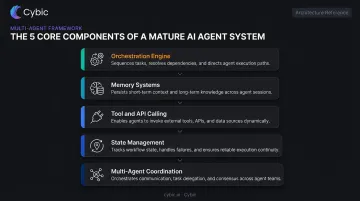
Core Components Every Mature Framework Must Have
- Orchestration engine - controls which agent runs when, under what conditions
- Memory systems - both short-term (in-context) and long-term (persistent across sessions)
- Tool and API calling - enables agents to take real actions against external systems
- State management - tracks execution status, supports retries, checkpointing, and recovery
- Multi-agent coordination - defined communication patterns so agents don't work at cross-purposes
These components are the baseline. From there, the real differentiator is configurability - which is why this guide focuses on code-based frameworks built for engineering teams. No-code platforms onboard faster, but they trade away the control that complex production workflows demand.
Best Multi-Agent Frameworks for AI Development in 2026
The five frameworks below were selected based on architectural maturity, enterprise adoption, maintenance momentum, governance capabilities, and clarity of use case fit.
LangGraph
LangGraph is a graph-based orchestration framework within the LangChain ecosystem (it runs standalone as well) where agents, functions, and decision points are represented as nodes and transitions as edges. This structure gives developers explicit, debuggable control over complex workflows, including cyclic and conditional logic that most frameworks can't model cleanly.
What separates LangGraph from alternatives is its ability to handle cyclic, self-correcting reasoning loops (generate → execute → critique → loop) with full state persistence between iterations. LangChain cites Replit, Uber, LinkedIn, and Elastic as production users; LangChain's own case study covers Replit Agent's architecture and LangSmith's role in trace readability.
LangGraph's GitHub repository shows 33,600+ stars and 540+ releases, reflecting active, sustained development.
| Dimension | Detail |
|---|---|
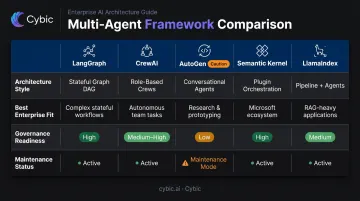
| Architecture | Graph-based (nodes + edges); supports cyclic, hierarchical, and sequential workflows with shared persistent state |
| Best Enterprise Fit | Complex multi-step automation, autonomous research agents, iterative reasoning tasks in manufacturing or ops |
| Governance & Observability | LangSmith integration for tracing state transitions; LangSmith Enterprise provides RBAC and tamper-resistant audit logs with up to 400-day retention; supports human-in-the-loop checkpoints |
CrewAI
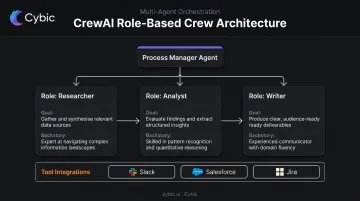
CrewAI organizes agents into crews (each agent has an explicit role, goal, and backstory), executing tasks sequentially or hierarchically under a process manager. This opinionated structure is both its constraint and its advantage: agent behavior becomes predictable, auditable, and far easier to debug than open-ended conversational systems.
CrewAI's official pages report use by 63% of the Fortune 500, with logos including Docusign, Experian, PepsiCo, IBM, and Johnson & Johnson. The platform integrates with hundreds of open-source tools including Gmail, Slack, Jira, Salesforce, HubSpot, and Microsoft Office 365 - plus a no-code UI Studio for non-engineer team members. That combination of role-based structure, broad tool coverage, and a no-code interface makes CrewAI a practical fit for teams that need governance without building orchestration infrastructure from scratch.
| Dimension | Detail |
|---|---|
| Architecture | Role-based crews with sequential or hierarchical process execution; Process Manager Agent handles conflict resolution |
| Best Enterprise Fit | Content pipelines, financial operations, compliance workflows, healthcare record automation requiring clear audit trails |
| Governance & Observability | Enterprise RBAC, entity-level permissions, OAuth integrations, scoped deployments, and restricted logs/metrics; agent monitoring dashboard included |
AutoGen
AutoGen is Microsoft Research's open-source multi-agent framework built on asynchronous message passing. Every participant (human, LLM-agent, or code executor) is a configurable ConversableAgent communicating via event-driven messages rather than synchronous function calls. Version 0.4 introduced a redesigned asynchronous, event-driven architecture with Core, AgentChat, and Extensions layers.
One important note for enterprise buyers: AutoGen's GitHub repository currently states the project is in maintenance mode, with Microsoft directing users toward the Microsoft Agent Framework as its successor. AutoGen remains valuable as research lineage and for experimentation, but teams should verify roadmap fit before committing it to production.
AutoGen Studio provides a low-code interface for prototyping; AutoGenBench measures agent performance on standard benchmarks.
| Dimension | Detail |
|---|---|
| Architecture | Conversational/event-driven; asynchronous messaging between ConversableAgents; supports hierarchical team nesting |
| Best Enterprise Fit | Autonomous software engineering pipelines, collaborative problem-solving, human-agent hybrid workflows |
| Governance & Observability | Requires custom logging and tracing for enterprise audit trails; framework-native RBAC and encryption must be implemented at the hosting application or cloud layer |
Semantic Kernel
Semantic Kernel is Microsoft's enterprise-focused, open-source SDK for embedding AI capabilities into existing .NET, C#, Python, and Java applications. It organizes agent capabilities as plugins that a central planner sequences to fulfill requests - treating both LLM functions and legacy API calls as interchangeable components. GitHub shows approximately 28,000 stars and 270+ releases.
This is the default choice for organizations with existing C# or Java infrastructure (particularly in finance, healthcare, and government) that need AI agents to interact with legacy SQL databases, SOAP endpoints, or internal enterprise APIs. KPMG used Semantic Kernel to deliver agentic workflows for its Clara AI platform serving audit professionals - one of the clearest verified examples of the framework in a regulated production environment.
Microsoft's own documentation confirms that Semantic Kernel and AutoGen are being harmonized, with Semantic Kernel positioned as the production-ready SDK layer.
| Dimension | Detail |
|---|---|
| Architecture | Plugin/skill model with central planner; polyglot support (Python, C#, Java); middleware pattern for existing app integration |
| Best Enterprise Fit | Legacy system modernization, regulated industries (banking, healthcare, government), Microsoft-centric enterprise stacks |
| Governance & Observability | Strongest built-in governance; formal planner structure; hooks for security filtering, monitoring, telemetry, and enterprise compliance |
LlamaIndex
LlamaIndex started as a retrieval-augmented generation (RAG) data layer; it now functions as a full agent framework. Its workflow model is explicitly event-driven: steps are triggered by events and emit events in response, running asynchronously on Python's asyncio loop - without requiring predefined graph paths.
Where LlamaIndex excels is when agents need reliable grounding in large volumes of proprietary or complex data. Cemex uses LlamaIndex to support supply chain, operations, and customer-experience knowledge workflows - a real production example of the data-centric positioning. The framework's GitHub repository shows 49,800+ stars and 7,500+ forks, with active releases as recently as May 2026. Note that security and compliance features such as granular access controls and HIPAA/GDPR/SOC 2 positioning come with LlamaIndex's commercial platform - teams using the OSS framework need to verify what controls they're implementing themselves.
| Dimension | Detail |
|---|---|
| Architecture | Event-driven workflows; steps triggered by events with shared context; no predefined graph paths required |
| Best Enterprise Fit | Research assistants, internal knowledge copilots, supply chain intelligence agents, healthcare data Q&A systems |
| Governance & Observability | Structured data governance via ingestion pipelines; RAG tracing available; human-in-the-loop via event hooks; full compliance controls require commercial platform or custom implementation |
How to Choose the Right Framework
According to Gartner, 40% of enterprise applications will include task-specific AI agents by 2026, up from less than 5% in 2025. That growth means selection decisions made now will determine production architecture for years.
Frameworks were evaluated here not on feature lists alone, but on how each handles three challenges that cause production failures:
- State management overhead at scale - maintaining consistency across long-running, distributed workflows without performance degradation
- Communication latency under high concurrency - whether agent coordination holds up when hundreds of tasks run in parallel
- Governance gaps in compliance-sensitive environments - audit trails, access controls, and human oversight need to be embedded architecturally, not retrofitted
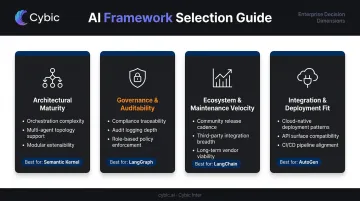
Key Selection Dimensions
- Architectural maturity: Match the framework to your workflow pattern - LangGraph for cyclic/self-correcting flows, CrewAI for role-defined team tasks, Semantic Kernel for polyglot enterprise stacks.
- Governance and auditability: In healthcare, financial services, energy, and government, compliance must be embedded architecturally. Semantic Kernel and CrewAI Enterprise offer the clearest pathways out of the box; frameworks that require bolted-on controls introduce structural risk at scale.
- Ecosystem and maintenance velocity: An IEEE/ACM study found 16% of sampled open-source projects were abandoned, with 41% surviving only through new core developers. AutoGen's maintenance-mode status is a live example. Prioritize frameworks with institutional backing or demonstrably active communities.
- Integration and deployment fit: Confirm the framework connects cleanly to your existing data sources, APIs, and security layers - and that it deploys across cloud, hybrid, or on-premise without vendor lock-in.
In regulated sectors - oil and gas, healthcare, manufacturing - Cybic's engineering team treats governance-by-design as a first-pass architectural requirement, not a post-build addition. Systems with compliance embedded structurally are substantially easier to audit, extend, and hand off than those where controls are added after the fact.
Conclusion
Framework selection shapes everything downstream. The right choice accelerates deployment and scales reliably; the wrong fit produces systems that work in demos but fail in production - and require expensive rewrites once real-world constraints surface.
A few practical recommendations before you commit:
- Start with a single-agent proof of concept within your chosen framework before committing to full production deployment
- Evaluate maintenance momentum - check GitHub activity, release cadence, and whether the project has institutional backing or depends on a small maintainer group
- Treat governance as a selection criterion, not a post-deployment task, not a post-deployment task. In regulated environments, audit trails, RBAC, and data privacy requirements are hard constraints - not optional additions.
For enterprise teams building multi-agent systems where governance, compliance, and infrastructure integration can't be retrofitted, Cybic's engineering team designs and deploys these systems across healthcare, manufacturing, energy, and retail.
If you're evaluating an implementation partnership, reach out to discuss what that engagement would look like for your organization.
Frequently Asked Questions
What is the difference between a multi-agent framework and a single-agent framework?
A single-agent system uses one LLM to handle tasks sequentially, processing everything through one model. A multi-agent framework coordinates multiple specialized agents that divide responsibilities, communicate, and operate in parallel - enabling more accurate, scalable handling of complex workflows that would overwhelm a single model's context or capability.
Which multi-agent framework is best for enterprise use in regulated industries?
Semantic Kernel and CrewAI are the strongest choices for regulated environments. Semantic Kernel suits .NET/Java stacks with its enterprise security hooks and formal planner structure; CrewAI's role-based architecture provides clearer compliance pathways and more structured governance than AutoGen out of the box.
Can multiple multi-agent frameworks be used together in the same project?
Yes - a common pattern uses one framework as the orchestrator (LangGraph managing workflow logic) while another handles agent collaboration (CrewAI managing role-based teams). However, combining frameworks adds architectural complexity and requires deliberate design around state sharing and inter-framework communication.
How do I choose between LangGraph and CrewAI for complex workflows?
LangGraph gives fine-grained control over conditional branching, cyclic loops, and execution tracing - best when workflow logic is non-linear or requires detailed observability. CrewAI is better when tasks map naturally to distinct agent roles and faster time-to-production matters more than custom orchestration logic.
What are the biggest risks of adopting an open-source multi-agent framework in production?
Maintenance velocity is the first risk: frameworks can become outdated quickly, and institutional backing matters - AutoGen's shift to maintenance mode is a recent example. Compliance governance is the second: most open-source frameworks lack built-in audit trails and RBAC, so teams must build governance layers on top of the base architecture.
How do multi-agent frameworks handle data privacy and security in enterprise deployments?
Security capabilities vary by framework. Semantic Kernel has the strongest built-in enterprise security hooks; LangSmith provides RBAC and tamper-resistant audit logs for LangGraph deployments; CrewAI Enterprise offers entity-level permissions and scoped deployments. AutoGen requires custom implementation of encryption and access controls at the hosting layer.