Introduction
Enterprise procurement teams are buried under fragmented workflows. Supplier validation stalls in email threads. Approvals queue up waiting for the right person. And even when individual tools are "automated," humans still stitch the steps together - copying data between systems, chasing approvals, manually routing exceptions.
The problem isn't a lack of automation. It's that automation has been applied in silos. According to Ardent Partners' 2024 State of Source-to-Pay Benchmark Report, 48% of procurement teams cite poor data quality or access as a primary technology barrier, and 34% flag lack of integration with third-party systems. Individual point solutions can't fix that.
Multi-agent procurement systems take a different approach. Instead of automating isolated tasks, they deploy specialized AI agents that collaborate, hand off context, and execute end-to-end workflows - removing the manual glue work between steps entirely.
This article covers how these systems are architected, layer by layer, and how to implement them in practice: from first pilot to production scale.
Key Takeaways
- Multi-agent systems use specialized AI agents (intake, sourcing, supplier, contract, PO/payment) coordinated by an orchestration layer to automate the full procure-to-pay cycle.
- Five architectural layers - data foundation, ML/reasoning engine, specialized agents, orchestration, and integration connectors - keep the system modular and extensible.
- Phase implementation: validate one high-volume use case first, then expand horizontally.
- Governance belongs in the architecture from day one: RBAC, audit trails, data isolation, and tiered human escalation - not retrofitted later.
What Is a Multi-Agent Procurement System?
A multi-agent procurement system is a coordinated network of specialized AI agents, where each agent owns a discrete task - classifying a purchase request, validating a supplier record, reviewing contract clauses - and passes structured outputs to the next agent rather than waiting for a human to move the work along.
Single-agent automation handles one task in isolation. It completes a step and stops - with no context about upstream inputs or downstream dependencies. A multi-agent system carries that context forward across every handoff.
Why Procurement Fits This Model
The procure-to-pay lifecycle is inherently sequential and interdependent:
Intake → Sourcing → Supplier Vetting → Contracting → PO → Payment
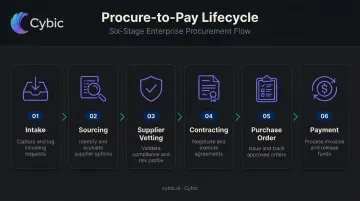
Each stage depends on the output of the last. When context-aware agents handle each step, structured data flows forward automatically - no manual handoffs, no status emails, no work stalled in someone's queue.
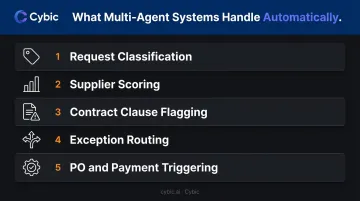
In practice, that means agents operating across the full cycle can:
- Parse and classify purchase requests against spend categories and budget codes
- Score and shortlist suppliers based on compliance data and historical performance
- Flag contract clauses that deviate from approved templates
- Route exceptions to the right approver with full context already attached
- Trigger PO generation and payment upon verified contract execution