Introduction
Process manufacturers are caught between forces that aren't letting up. Margins are compressing as input costs rise: European ethylene production costs ran 3.2 times higher than U.S. costs in 2023, according to Cefic. Over 51% of U.S. chemical manufacturers expected regulatory burden to increase over the following six months, per ACC's Q2 2024 survey. Meanwhile, Deloitte projects U.S. core infrastructure sectors - including oil and gas - will need 6.1 million new essential workers over the next decade.
The operational pressure shows up on the floor: unplanned downtime that cascades into batch failures, quality deviations caught too late to recover yield, and compliance documentation that still runs through spreadsheets and manual sign-offs.
Incremental fixes don't close gaps this wide. Scheduling more maintenance checks or adding another reporting layer doesn't address the underlying problem: operations still depend on reactive, rule-driven systems designed for a different era.
This article covers what intelligent automation actually means for process manufacturers (chemicals, pharmaceuticals, food and beverage, oil and gas) - the technologies involved, where it delivers measurable value, and what separates solutions worth deploying from ones that stall in pilot.
Key Takeaways
- Intelligent automation combines AI, ML, RPA, and IIoT into one adaptive system that learns from operational data rather than following fixed rules
- Process manufacturing benefits most from predictive maintenance, real-time quality monitoring, and cross-functional workflow orchestration
- Unlike traditional automation, intelligent systems adjust dynamically as process conditions change
- Governance and compliance must be architected into automation systems from day one, not retrofitted once problems emerge
- Measurable outcomes include reduced unplanned downtime, lower per-unit maintenance costs, and tighter batch-to-batch product consistency
What Is Intelligent Automation in Process Manufacturing?
Intelligent automation (IA) combines AI, machine learning, robotic process automation (RPA), and business process management (BPM) into systems that execute tasks, learn from outcomes, adapt to changing conditions, and surface decisions - without waiting for manual reconfiguration. Traditional rule-based automation follows fixed instructions. When conditions fall outside predefined parameters, it stops working correctly and requires human intervention to reconfigure it.
Process manufacturing makes this limitation especially costly.
Why Process Industries Are Different
Unlike discrete manufacturing - where you assemble identifiable parts in predictable sequences - process manufacturing runs continuous production cycles with deeply interdependent variables. A temperature shift in a chemical reactor affects pressure, flow rates, yield, and downstream separation simultaneously.
Sensor ecosystems span DCS, SCADA, and PLCs generating thousands of data points per minute. Regulatory environments in pharma, chemicals, and energy demand full documentation of every process parameter.
These conditions consistently break traditional automation. McKinsey found that in cement operations, throughput and energy use fluctuate by more than 50% from average - variability that conventional control systems cannot manage reliably.
Intelligent automation addresses this through a core intelligence layer: AI models analyze real-time sensor and control system data, identify patterns or anomalies, and either trigger automated responses or surface recommendations to operators. Operations shift from reactive to proactive.
Traditional vs. Intelligent Automation
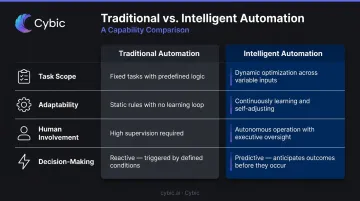
| Dimension | Traditional Automation | Intelligent Automation |
|---|---|---|
| Task scope | Predefined, fixed tasks | Dynamic process optimization |
| Adaptability | Static rules | Continuously learning |
| Human involvement | High supervision required | Autonomous with human oversight |
| Decision-making | Reactive | Predictive |
Intelligent automation in process manufacturing is designed to free operators from low-value monitoring work, not replace them. That means less time on:
- Watching dashboards for anomalies
- Manually logging readings and reconciling shift reports
- Responding reactively to alerts that could have been predicted
Operators redirect that time toward process optimization and safety decisions - where human judgment has real impact.
Core Technologies Powering Process Manufacturing Automation
AI and Machine Learning
AI models trained on historical and real-time process data can predict equipment failures before they occur, detect quality deviations as they develop, and autonomously optimize parameters like temperature, pressure, and flow rates. This is the decision engine of the entire IA stack - without it, the other technologies are just data collectors.
Robotic Process Automation (RPA)
RPA handles the back-office and workflow layer: purchase order processing, compliance documentation, batch record generation, and shift reporting. These tasks consume significant operator time and introduce errors when done manually. RPA eliminates the manual handling without requiring changes to existing underlying systems, since it operates at the application interface layer.
IIoT and Sensor Networks
The global industrial IoT market reached an estimated $194.4 billion in 2024 and is projected to hit $286.3 billion by 2029 (MarketsandMarkets). In process manufacturing, IIoT connects production equipment, sensors, and edge devices to stream operational data into AI systems in real time. The quality and latency of this data layer determines how much the AI layer can actually do.
Digital Twins
A digital twin is a virtual replica of a physical process or plant. In process industries - where experimenting on the actual production line means risking product quality, safety, and regulatory compliance - digital twins let teams simulate scenarios, test parameter changes, and validate configurations before touching live operations.
LNS Research identifies digital twins as a centerpiece of digital transformation in batch and continuous process manufacturing.
Integrated Data and AI Platforms
The most common failure mode in manufacturing automation is solid technology deployed in silos. When systems don't talk to each other, the value they generate stops at their own boundary:
- A predictive maintenance model that doesn't connect to the scheduling system triggers alerts no one acts on
- A quality deviation flag that doesn't feed back into process control catches problems too late
- Separate analytics dashboards that don't share a data model produce conflicting numbers
Effective intelligent automation requires a unified platform connecting raw data, machine learning models, AI reasoning, and workflow orchestration. Cybic's Drava platform is built for this: it connects enterprise data, ML and data science, AI reasoning, and intelligent agents into one governed architecture, replacing a collection of disconnected point tools with a single integrated system.
Key Applications Across Process Manufacturing Operations
Predictive Maintenance and Asset Reliability
According to Siemens' downtime research, unplanned downtime costs Fortune Global 500 industrial organizations nearly $1.5 trillion annually - roughly 11% of annual turnover. In oil and gas specifically, one hour of unplanned downtime costs nearly $500,000.
AI-driven predictive maintenance works by continuously monitoring equipment health signals (vibration patterns, temperature trends, pressure variance) and predicting failure windows before they cause outages. Maintenance teams schedule interventions during planned downtime rather than scrambling during production.
The benchmarks from Deloitte and Siemens suggest predictive maintenance can:
- Reduce unplanned downtime by up to 50%
- Lower maintenance costs by 25–40%
- Increase overall productivity by approximately 25%
- Reduce breakdowns by up to 70%
These are industry benchmarks, not guarantees - outcomes vary by asset type, data quality, and implementation maturity.
Automated Quality Control and Process Monitoring
Manual sampling cycles are too slow for continuous production lines. By the time a lab result comes back out of spec, thousands of units may already be affected.
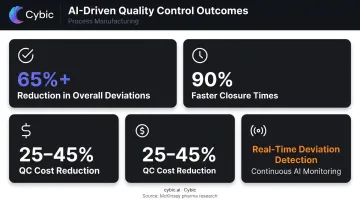
AI-driven statistical process control (SPC) systems monitor product quality in real time, detect deviations as they develop, and trigger corrective adjustments automatically. McKinsey's analysis of pharma QC digitization found reductions of more than 65% in overall deviations and over 90% faster closure times in some implementations. For chemical QC labs, digitalization could reduce costs by 25–45%.
Intelligent Workflow Orchestration
AI-powered workflow engines coordinate across functions: production scheduling, material procurement, batch changeovers, and shift handoffs. They analyze real-time data and optimize sequencing continuously.
Bottlenecks that previously went unnoticed until a shift supervisor spotted idle time become visible to the system in advance, with automated adjustments to sequencing and resourcing before output is affected.
Supply Chain and Demand-Driven Production
Overproduction and stock shortages both destroy margin. AI-driven forecasting integrates market signals, historical order data, and production capacity to align volumes with actual demand. McKinsey's supply chain research found that AI forecasting delivers measurable results:
- Reduces supply-chain errors by 20–50%
- Decreases product unavailability by up to 65%
- Lowers warehousing costs by 5–10%
AI Copilots for Operator Decision Support
Operators shouldn't need a data science background to act on sensor data. Generative AI copilots on the plant floor flag contextual alerts, recommend process adjustments, and translate complex sensor readings into plain-language guidance. An operator dealing with an unusual pressure variance gets an actionable recommendation, not a raw data export to interpret manually.
Cybic builds enterprise GenAI copilots that integrate with existing operational platforms, connecting AI reasoning to the data systems operators already use - without requiring them to change workflows or learn new interfaces.
From Data to Decisions: The Business Case
Operational Cost Reduction
Intelligent automation addresses several cost levers simultaneously:
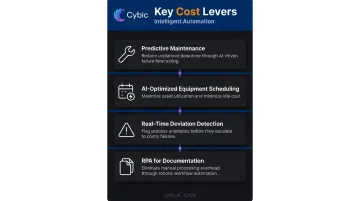
- Predictive maintenance prevents the most expensive production interruptions before they occur
- AI-optimized equipment scheduling cuts idle energy use - a North American cement operation achieved up to 10% throughput and energy efficiency improvement in autonomous mode (McKinsey)
- Real-time deviation detection stops off-spec production before it accumulates into costly rework
- RPA eliminates manual data entry across batch records, purchase orders, and compliance documentation
Productivity and Throughput Gains
Continuous monitoring and automated process optimization compound over time. The gains aren't dramatic on any single shift - they accumulate across every hour equipment runs closer to optimal parameters, not just when an experienced operator is watching.
Changeover times shrink when AI pre-stages material procurement and sequencing. Schedules become more predictable, which tightens both delivery performance and resource planning.
Workforce Augmentation
Intelligent automation redistributes human effort rather than eliminating jobs. Operators move from reactive monitoring to strategic oversight - a shift that changes what a small team can accomplish.
Automated systems take on:
- Data collection and sensor logging
- Anomaly detection and early-warning alerts
- Routine compliance reporting
Small teams become more effective without adding headcount.
Governance, Security, and Compliance by Design
Regulatory Compliance in Process Industries
Process manufacturing operates under some of the most demanding regulatory frameworks in any industry:
- Pharma: FDA 21 CFR Part 11 requires secure, computer-generated, time-stamped audit trails for all electronic records - including records created, modified, or deleted by automated systems
- Chemicals: EPA standards govern emissions, waste handling, and process safety
- Energy: OSHA requirements cover operational safety and incident documentation
Any intelligent automation solution deployed in these environments must maintain full auditability and traceability of automated decisions. Regulators don't accept "the system did it" as an explanation - they want documented evidence of what the system did, when, and based on what data.
Security and Data Governance Requirements
Claroty's 2025 analysis of OT security across 940,000+ devices in pharma, chemical, and oil and gas found that 12% of OT devices contained Known Exploited Vulnerabilities and 40% of organizations had assets insecurely connected to the internet. Deploying AI automation into an environment with these exposures - without embedded security controls - creates serious risk.
Cybic builds governance directly into its automation architecture rather than adding it afterward. Every deployment includes:
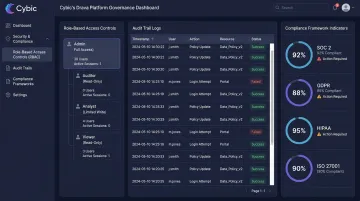
- Role-based access controls (RBAC) enforced at the architectural level
- Data encrypted in transit and at rest
- Full auditability with logged, traceable records of every AI-driven action
- Client data protected from model training use
- SOC 2, HIPAA, ISO, and GDPR compliance frameworks built into the design
Infrastructure Flexibility
Most process manufacturers run legacy DCS, SCADA, and ERP systems representing decades of investment - replacing that infrastructure on a short timeline simply isn't feasible.
Cybic designs infrastructure-agnostic solutions that integrate with existing control systems and enterprise applications across cloud, hybrid, and on-premise environments. The architecture connects to what's already there through custom API development and platform integration - improving capability without forcing a disruptive overhaul.
Frequently Asked Questions
What is an intelligent process automation solution?
An intelligent process automation (IPA) solution combines AI, machine learning, and RPA to automate entire business processes - not just individual tasks. These systems make decisions based on live process data, adapt to changing conditions, and improve continuously without manual reprogramming.
What are the four types of intelligent systems?
The four commonly referenced types are:
- Reactive machines - respond to inputs without memory
- Limited memory systems - learn from historical data (most modern AI falls here)
- Theory of mind systems - understand human intent (still emerging)
- Self-aware systems - hypothetical; no working examples exist
Manufacturing AI today primarily operates as advanced limited memory systems.
What technologies are used to automate manufacturing processes?
The primary technologies are AI and machine learning, RPA, IIoT sensor networks, digital twins, and workflow orchestration platforms. These work together rather than in isolation: IIoT supplies the data, AI interprets it, RPA executes workflows, and orchestration platforms coordinate across functions.
How does intelligent automation differ from traditional automation in manufacturing?
Traditional automation follows fixed, pre-programmed rules and requires human intervention when conditions change. Intelligent automation uses AI to learn from data, adapt dynamically, and make decisions - making it suitable for the complex, variable conditions that define process manufacturing environments.
What are the biggest challenges in implementing intelligent automation in process manufacturing?
The main barriers are: integrating with legacy DCS and SCADA systems, ensuring data quality across heterogeneous sensor networks, managing workforce change, and embedding security and compliance controls into the architecture from the start.
How does AI-driven automation support regulatory compliance in process industries?
AI automation supports compliance by maintaining complete audit trails of automated decisions, enforcing consistent process parameters, generating regulatory documentation automatically, and flagging deviations in real time. Real-time deviation flagging alone closes a gap that manual, paper-based processes typically cannot address until after an audit.